Showing posts with label sci-fi. Show all posts

Friday, 3 April 2015

Space Alert, Part 2: Gameplay & Verdict

In our last article we took our first step back into the world of regular reviewing, by taking a look at the box contents for Vlaada Chvatil's Space Alert, published by Rio Grande Games.  Space Alert is a co-operative game for 1-5 players (side note: we'd love to know how a competitive game for 1 player would work... answers on a postcard), in which the players take on the roles of expendable crew members on a short-range interstellar vessel.  Here we'll be taking a look at how the game plays, and giving it our coveted* final score (*Games & Tea final score may not actually be coveted).


Before the game can begin, players must first of all squabble amongst themselves over their roles in the crew.  As mentioned in the box contents article, the pace of the action is dictated by the ship's computer - relayed either via the accompanying CD or the smartphone app.  This means that one crew member must be designated as the communications officer.  Whilst all hell is breaking loose on board the ship, robots are malfunctioning, and aliens are attacking, it's the duty of the communications officer to closely listen to the ship's computer and ensure that no updates are missed.  Obviously all crew members can hear these updates, but the comms officer is the expendable man or woman responsible for none of them slipping through.
The other role to be assigned is that of the ship's captain.  Space Alert is a co-operative game, but it's also a real-time one, which means that there is rarely enough time to sit around and discuss various options to a newly revealed threat.  The ship's captain serves two purposes: firstly, to have the final say on any conflicting courses of action from the other crew members, and the other we'll come to shortly.

"Captain's log, stardate Tuesday... point two."

Once the crew roles are have handed out, it's time to set up the board.

As the first part of this review showed, there are a fair few components to Space Alert.  In spite of this, however, the setup process of the game is actually very quick and straightforward.  Threat Vectors are randomly drawn and assigned to the four sections of the ship previously mentioned (left, right, center, and internal), the jelly cubes representing the power to the ship's systems are assigned to their starting points, the threat decks are shuffled (internal and external still kept separate), the combat robots sent to their charging stations, and the crew members placed on the bridge.  If all has been done properly, you'll be left staring at something like this...


Then it's time to hand out the Action Cards and start the game!  You may have noticed in Part 1 of the review that the Action Boards are split into three sections, containing the numbers 1-3, 4-7, and then 8-12 respectively...


These are the three mission sections, and the individual numbers represent the turns of the game (we know, we said this was a real-time game, but all will make sense as you read on!).  Before the game starts, each player is dealt 5 Action Cards for each section of the board, which are placed on those sections face-down.  The computer will call out the beginning and end of each mission section - during the active section, each player may assign Action Cards to any turns they wish, and rearrange them as many times as necessary to adapt to changing circumstances.  Once the mission section is over, however, and the next section begins, those Action Cards are then locked in place and cannot be changed.


Each room of the ship has contains three different buttons; A, B and C (easy to remember!).  Button A fires the weapons system in whichever room the player is standing at the time, button B is used for raising the shields or charging the reactor, depending on location, and button C is a bit more specialist, being used to fire missiles, maintain the computer, launch fighters, activate robots, or just look out the window (no, we're not even joking about that final one!). Each Action Card includes a movement arrow and one of those three actions, so players can choose to use them to either move around the ship or activate one of the ship's systems.
The trick in Space Alert is to make sure that the crew are accounting for all of the ship's systems.  Firing the lasers and charging the shields both draw energy from the ship's reactor, and that reactor must be periodically refilled.

Now pay attention, crew, for this is where the second role of the captain comes into effect!

Actions are resolved in order, starting from the captain and working clockwise around the board, so it's important for players to keep this in mind when planning their moves.  It's great to charge the reactor in preparation for a full-on laser bombardment, but if the person charging the reactor is taking their turn after those firing the weapons, then all you'll be left with is a crew member hammering on an innefective 'fire' button whilst a colossal alien warship descends upon you!

Let's have a look at an example below...


In this scenario, the blue player has locked their choices in for the first two mission sections, but the third has not yet begun.  When deciding whether to move or activate a system, the top half of the Action Card is the one to go by.  In this run here the player fired the ship's lasers (A), moved to the room on the left, charged the shields (B), took the elevator down, refilled the reactor (B), went back up in the elevator, and then fired the lasers (A).

Obviously players may not always have the cards in their hands for the actions they'd like to take, and this is where it becomes important to organise amongst eachother.  It's not all doom and gloom though, as the computer will occasionally call out "incoming data" or "data transfer", which allow players to draw new cards or exchange between eachother respectively.

The most important thing which the computer will call out are threats.  Only one threat can appear during each turn, so if the computer calls out "Time T-1, threat blue", it means that a threat will start approaching in turn 1 on the right hand section of the ship (the blue section)...


Here a sneaky Stealth Fighter has just appeared.  It begins at the top of the Threat Vector and advances each turn.  Every time it passes a letter on the Vector, it carries out the action marked on the card - for example, the Stealth Fighter cannot be attacked until it hits the X.  Once it hits the Y it deals 2 damage to the ship, and then another 2 when it hits Z, so it's in the best interests of the crew to blow it out of the stars before that can happen.

The mission continues for 12 minutes, as the crew tries to keep everything in working order and the ship in one piece, up until the computer mercifully calls out "hyperspace jump in 3, 2, 1... *whoosh*", and you all live to fight another day.

...or do you?


At the end of the box contents article there was a board we skipped over, so this comes into effect now.  It turns out that during the 12 minutes of real-time action the players are basically just planning out which actions they're going to take in each of the 12 turns.  This card is effectively the black box recording for the crew's (probably) ill-fated mission, and only once the CD/app track has finished do the players finally play through the actions and see how everything actually panned out.
This part of the game can prove absolutely hilarious, and it's fun for the players to now imagine themselves as a board of directors, face-palming their way through a 12-minute recording of the most inept crew in existence.
Indeed, in one of the USS Games & Tea's first outings, our illustrious communications officer was convinced he'd saved the day against that pesky Stealth Fighter.  In reality, he hadn't realised the targeting restriction on it, spent two turns firing the laser at empty space until the reactor was empty, and then watched in absent-minded glory as the Stealth Fighter proceeded to tear the ship to pieces.  We can only imagine the letter which must have been handed over to his next of kin.  

Now it might seem fairly straightforward from this description, but it's the little things which make Space Alert special.  For example, as the "How to..." manual states, there is no video link between the rooms on the ship, only audio, so players must place their Action Cards face-down on the Action Boards.  This means that all players MUST communicate with eachother, as they can't simply sneak a peek over at their shipmates' boards to see what they're up to.  One of the problems with this is that there will occasionally be a communications malfunction replacing the CD track with static, during which period the crew must continue without speaking to eachother until it's resolved.
Other little touches can involve tripping over, being delayed in the elevators, running into bulkheads... if an incompetent crew of space-wannabes can do it, it's probably in Space Alert somewhere (one of our captains still tells heroic tales of the time he spent 3 turns staring out of the window as the ship disintegrated around him).

In terms of mechanics, there's not much more to tell really.  We've skimmed over some of the finer points, but those are for you discover on your own!  What did we think of it as a game though?

In a nutshell, this might be the finest co-operative game we've ever played.  It's intensive for those 12 real-time minutes, but that's a short-enough time to be fun rather than stressful.  Once the real-time section ends and the turn-based resolution begins, then it just becomes a very light hearted and humour-based game, and is terrific fun to have with friends.
One of the greatest things about Space Alert is that each player still very much feels like they're part of the game.  A big problem with many co-op games (Pandemic being a perfect example), is that the turns often devolve into 'turns by committee'.  Rather than each player taking their own actions, their turns end up being weighed up and discussed based on the actions of the preceeding and following players, and so individuality becomes lost entirely.  The fact that Space Alert is a real-time game eliminates this entirely, as there is simply not time to weigh up every option.  Players call out their planned actions, and have to work around eachother as they go, but their decisions and actions still feel very much their own, and this is an unbelievably rare thing in co-op games.
There are a lot of random elements to the game, especially with the addition of the smartphone app - the encounters are randomised, threats are randomised, Action Cards are randomised, damage to the shop is randomised... basically, there's enough to make sure that you'll never play the same game of Space Alert twice.
The short play time is also a massive bonus.  It's difficult to get bored when you're playing a game which only takes around half an hour, and is keeping you on your toes for every minute!  Whilst it's possible to customise the app with various difficulty settings, the default setting for Space Alert is incredibly challenging, and so it's very easy to fall into the "one more round" mentality, in an attempt to finally beat the game.  It's worth noting that here at Games & Tea we've never managed to win a game on the default setting yet, but the fact we'll still shout the game's praises from the rooftops shows that we consider it an enjoyable challenge, rather than a frustrating one.

As we've mentioned in previous reviews though, no game is perfect.  Space Alert comes pretty darn close, but we strongly doubt we'll ever see the unicorn that is the perfect game.  We stated above that there are a lot of random elements, and one criticism of the game is that there are perhaps too many.  The real-time section of the game is all about planning out your course of action, so when virtually every facet of the game is unpredictable, this can be a monumental challenge.  The counter argument to this would be that it makes for a more authentic gaming experience, but this is perhaps one of those times were authenticity and playability should perhaps be weighed against eachother.
The next downside is the learning curve.  The 'training program' is an inspired decision, and is a fool-proof way of teaching the complexities of Space Alert to new players.  The problem with this is that every time another new player joins the group, the experienced players have to sit through the comparatively slow-paced training missions again until everyone's up to speed.  In fact the first few weeks with the game at our FLGS seemed to be mired in training missions, as there was always someone new who wanted to try it out, taking us all back to square one.
The other negative point to Space Alert is that it doens't work quite as well with fewer players.  It's impossible to play the game with fewer than four crew members, so if there are three players or less then the extra crew members are controlled by everyone, and each player received extra Action Cards in each section to make up for this.  While this is probably the best way to resolve the issue of fewer players, it still doesn't work particularly well, and a single-player game of Space Alert is pretty much unplayable.

The Good Points
  • Space Alert is the first truly co-operative game we've played, as opposed to a 'turn by committee' game.
  • 4 and 5 players are accommodated nicely, making it a good game for slightly larger groups.
  • The real-time element makes it a fun and frantic game, and the 'black box' resolution card brings the game to a very entertaining conclusion.
  • There are enough random elements to make every single playthrough different.
  • Excellent tutorial mode.
  • Extremely challenging.
  • The computer soundtrack makes the game very immersive.
The Bad Points
  • Perhaps too many random elements, leaving little room for planning.
  • The game fails to deliver with only 1 or 2 players.
  • Constantly repeating the training missions for new players can be frustrating.

Recommended Number of Players: 4-5
As mentioned above, Space Alert doesn't really work with 1 or 2 players.  3 should be considered the minimum for a decent game, but it plays best with 4 or 5, as this eliminates the need for a collectively-controlled extra crew member.

Average Game Time: 30 minutues
The playthrough time on Space Alert is pretty standard.  The real-time section is always around 12 minutes (once the training missions have been passed), and the resolution stage usually takes a little longer, so a single sitting clocks in around the half-hour mark.

Replay Value: Very High
With a relatively short play time, high number of randomly-generated elements, and challenging gameplay, Space Alert has all of the right ingredients for a highly replayable game.  With expansions available to enhance the game further, this is one which we can't imagine gathering dust for a very long time.

The Future: Lost to the Depths of Space...
Space Alert is a fantastic game, and the The New Frontier expansion adds even more to this, but as far as we can tell this is the extend of the Space Alert story.

Price: £40
Space Alert will set you back £40, meaning it's not one of the cheapest games out there, but not one of the most expensive either.  We'd certainly say that we've got our money's worth out of it.  In terms of availability, we rarely see it on the shelves in gaming stores, but being from a large manufacturer it should be easy enough to order in.

OVERALL SCORE: 9.5/10
Tea consumed during this review: Twinings English Afternoon, 3 minutes brew time, 2 sweeteners, dash of milk. Brew rating: 10/10


If you enjoyed this article and want to see more of the same, come and like us on our Facebook page to keep up to date with our reviews, as well as our general day-to-day ramblings!

Wednesday, 1 April 2015

Space Alert, Part 1: Box Contents

Well at this point we certainly can't be accused of keeping on top of our game reviews!  For many and varied reasons we've dropped off the face of the gaming earth for the last several months, but just because we haven't been reviewing doesn't mean we haven't been playing!  Obviously the downside is that our readership numbers have dropped off, and we can't blame anyone for that, but on the plus side it now means we have a bunch of games which we have well and truly played to death, which we're ready to approach with a reviewers mindset now!
So to end our reviewing drought, we're going to be taking a look at Space Alert by Vlaada Chvatil, from Rio Grande Games.


Space Alert is a co-operative board game for 1-5 players, set on a short-range interstellar exploration vessel which is apparently entirely crewed by people dressed like Cyclops from X-Men.  The role of the ship is a simple one: execute a hyperspace jump to a nearby sector of space, spend 12 minutes scanning the area, and then hyperspace jump back to Earth to report the findings.  The ship is pre-programmed to carry out its mission.  The ship knows what it's doing.  The ship is valuable.

The crew are not.


That's right, Nostromo-wannabes, you're expendable (not to be confused with The Expendables, although if you're the captain I suppose you can order everyone else to call you 'Stallone').  The job of the crew on this noble voyage is to make sure that the ship stays in one piece for long enough to make that return jump, although with giant space jellyfish, malfunctioning robots, saboteurs and nuclear warheads, that's not going to be an easy task!

But we'll be getting into the real gritty details of the gameplay in the second part of the review.  For now, as always, we're going to be taking a look at the box contents so you know what to expect when you... well... examine the contents of the box.


Now just to be a bit different we're not going to start with the board, but with the rulebook.  Or, more accurately, the rulebooks.  As any self-respecting game should do, it comes with an in-depth (though, mercifully, not lengthy) rulebook with all of the gameplay mechanics clearly explained.  It also includes a second rulebook, entitled "How to be a Space Explorer in Seven Lessons".
Seeing as Space Alert is quite a complex game, it has a fantastic method of teaching new players how to play.  The "How to..." book is laid out and annotated like a training manual for space cadets, and slowly introduces players to the rules over a series of short training missions, by the end of which they'll have absorbed the full set of rules and are ready to play the game in full.  In fact the "How to..." book encourages new players to put the full rulebook to one side and start with just the guide, and everyone at Games & Tea has found it to explain the game perfectly, and trained us all up into fully expendable space explorers in no time.


Next up: the board.  The board in Space Alert gives an overview of the ship's layout, with the various ships systems, access doors/elevators, and so forth.  We were unsure earlier about whether to class Space Alert as a board game, as typically a gaming board features some kind of goal or endgame.  Here, the board is basically there just to keep a visual track on the chaos, as your crew desperately fights to keep the precious company property in spaceworthy condition.


We then come to the Threat Vectors.  Whenever an obstacle appears to threaten the ship, from within or without, its progress is tracked on an appropriate Threat Vector.  The threat vectors determine how quickly the threat reaches a catastrophic state, and how many times it deals slightly less catastrophic damage to the ship in the process.  One is assigned to the left-hand (red) side of the ship, one to the center (white), one to the right (blue), and one to the ship's interior.  There are seven of these in the game, but only a maximum of four are ever used, which allows for an element of randomisation.


If you're going to have Threat Vectors then you'd better damn well have some threats!  There are two Threat Decks in Space Alert, which are shuffled to add further randomisation.  The green deck consists of internal threats, so you'll find things like boarding parties, robot malfunctions, hacked shields and so on within this deck.  The purple deck consists of external threats, so this is where you'll be faced with stealth fighters, juggernauts, meteors, and the previously-mentioned giant space jellyfish.  The threats have various strengths and weaknesses, so it's up to the crew to work together to combat these before they tear the precious ship apart, and the bill for damages gets sent on to their next of kin.


So if you're going to combat these threats then I guess you're going to need to be able to move around the ship?  And push buttons?  And generally just do space-ship-type things?  Throughout the mission, each player can take 12 actions - these are determined using the Action Cards, and are planned out using each player's Action Track.


Generally it's a good idea to physically represent the players on the board.  Space Alert features 5 colourful crew tokens, which correspond to the colours of the Action Tracks.  Those grey-looking fellows at the back are the ship's combat robots, and can be led around the ship to fight off invaders... at least until they malfunction and start killing the crew.  Swings and roundabouts, eh?


No board game is complete without tokens, it seems, and Space Alert has them in spades.  The various tokens are used to keep track of internal threats as they move throughout the ship, the progress of external threats, and the damage dealt to the ship itself - that's right, the ship takes damage!  So if you don't work hard to keep it up and running, then that mega-laser you were counting on to save your skin at the last minute might not actually work so well.


And there are some assorted jelly cubes.  Okay, we were a little disappointed to discover they weren't actually jelly cubes.  These translucent plastic cubes and cylinders are used for various purposes in the game, but usually for keeping track of the ship's energy, which can be transferred between reactors, and assigned to weapons and shields.


We were thinking of leaving this out of Part 1 of the review, but seeing as this is a box contents article and this was in the box, we feel we should include it, but feel free to ignore it for now.  This overly-complicated-looking track is effectively the ship's black box recording, and all will make sense in Part 2!

At this point you may be thinking "Okay, you're keeping the ship in-tact, things are attacking you, I get that... but how do you know when/where the threats come from?"  This is one of our favourite parts of the game, and one that makes it quite immersive...


The CD!  Now we've played games with CD soundtracks before (most notably Last Night on Earth), and the soundtrack has done little to enhance the gameplay - in fact, if anything, it's detracted from the experience.  With Space Alert, however, things are different.  This is not a CD of cheesy music, but the audio track of the ship's computer.  Once you've selected a track and pressed play, the designated communications officer has to listen closely to know when and where the threats are approaching from, when players are allowed to exchange or draw new Action Cards, or can even cause a communications blackout, wherein players have to continue without communicating until the blackout resolves.
This makes Space Alert a real-time game, as opposed to turn-based, which adds to the chaos and tension of fending off attacks from all sides!  The CD only contains around 10 tracks, not including the training mission, but a free Mission Generator app can be downloaded for smartphones, which randomly generates missions and is a highly recommended addition to the game.

Well, that's quite a lot of content, isn't it?  Come back shortly to see how the gameplay breaks down and find out our final score on the game!  Until then, drink up, and game on!

Thursday, 19 December 2013

DreadBall Deluxe, Part 2: Gameplay & Verdict

Last week we stepped back into the world of board game/tabletop system hybrids as we took a look at the box contents for DreadBall; the futuristic sports game from Mantic Games.  Today we're going to run our two teams out onto the pitch and find out just how well it fares as a standalone board game, or if it should be confined to the collections of tabletop hobbyists.


The DreadBall starter box comes with two teams: The Trontek 29ers and The Greenmoon Smackers.  Of course players can paint their miniatures up in the default colour schemes and use these exact teams, but it's always good fun to come up with your own ideas, giving a little more personal investment in the 8 brave warriors of the sport who are being pummelled for your own amusement.  With this in mind our DreadBall Deluxe boxset has given rise to two new giants: The Cybertron Sentinels and The Arkham Outcasts!

The Cybertron Sentinels!

The Arkham Outcasts!  Okay we've only painted one so far, but orange is time-consuming, okay?
Both teams have a very different set of attributes which result in very different gaming experiences (which we'll come to in more detail later), so once players have decided which team they'll be fielding, it's time to set up the board.


Board set-up in DreadBall takes mere seconds, which is very refreshing when you look at many specialist board games on the market.  Once the board is opened up the score marker needs to be placed on the '0' point of the score track (shown along the bottom side of the board above), and the turn marker needs to be placed on '01' on the turn track (shown along the top side).  This concludes board setup!  Doesn't that make a lovely change?

Players must then decide who will be fielding the home team, and who will be the visitors.  This is decided randomly, so can be done either by dice-rolling or by one player randomly selecting the Home Fans or Away Fans card.  The home team will set their team up on the blue side of the board and use the blue dice from the set, with the away team following suit on the red side and with the red dice.  You may notice that the turn track is coloured to match these sides - this is because the home team always takes the first turn in DreadBall, after which play alternates until the final turn is played by the away team (unless one team has romped home with a 7 point clear victory before then).  Both teams also start with one coaching dice (a white dice), and one randomly-dealt card from the deck.  The remaining deck is placed face-down at the side of the board, and the remaining white dice placed to one side as well - these will be used to determine the referee's rolls when she's called upon to settle a dispute!  The number of starting cards and coaching dice varies from one team to the next across the DreadBall hobby, but the two teams in the balanced starter box begin with one of each.  Fair's fair after all!

The two teams each consist of 8 players, but the Deluxe box comes with an added bonus: two more players for each side.  This basically gives the players the options of customising their lineups a little, tailoring to more aggressive gameplay or allowing for speedier hit-and-run style strikes.  For new players though it's best to start with the basic lineup, and the rulebook contains the starting player lists for both of the featured teams.

There are three types of players in DreadBall: Guards, Strikers and Jacks.  All three of these feature in the 29ers, but the Smackers only contain Guards and Jacks.  A Guard is a big bruiser of a player, unable to pick up the ball themselves but good for Slamming (the DreadBall equivalent of a tackle) opposing players and causing some serious injuries.  Strikers are the nimble players who score most of the points.  They can't Slam, but can throw like demons and are great at dodging those hard tackles.  Jacks don't specialise in any one area, being able to Slam and take possession of the ball.  They're not as good as Guards or Strikers in their respective fields, but an all-rounder can be helpful when the time is right!
The Trontek 29ers team is quite Striker-heavy, meaning that it's a good team for making swift runs into the opponent's half to score those vital points.  The Greenmoon Smackers, on the other hand, have much tougher Guards and in greater number, which makes them a team best suited to knocking down your opponent's players, leaving an empty pitch for the Jacks to work their scoring magic on.

Of the 8 players in each team, only 6 are allowed on the pitch at any one time.  These 6 must be set up inside their respective halves before the game begins, with the 2 remaining players starting on the substitutes' bench.  DreadBall is a very physical game, so don't worry, they'll be on the pitch with their chance to shine before you know it!

Steve Batman of The Arkham Outcasts shakes a threatening fist at Megatron and the rest of The Cybertron Sentinels!
Once players have set up their teams and the ref-bot has been placed on her starting space, it's time to launch the ball and begin the game!

Each turn in DreadBall is referred to as a "Rush", and Rushes alternate between players.  This means that you don't have to worry about your opponent messing with your best laid plans during your turn, but it also means that by the end of your turn you need to have your players positioned and prepared for anything your opponent may throw at you during their Rush.
In a player's Rush they may take up to a total of 5 actions, and they can keep track of these using their player tokens.  In addition to this 5 action limit, each individual player on the team may only take up to 2 actions, which is a good way of preventing a player from heaping actions onto a single member of their team and dashing across the field to score easy points!  That said, lucky dice-rolling can reward players with free actions which do not count towards either of these limits, which can allow moments of sporting heroism to creep into the game.  Indeed, in one of our review games we had a player jump off the subs bench and sprint the full length of the pitch to score the game-winning points in a move worthy of any inspirational sporting film!
On top of these, cards can be played to give players further free actions, or can even put an ongoing effect into play which can affect the entire flow of the game.
A player's Rush ends when they have no further action points to spend, or when they lose possession of the ball, either from a missed shot, a failed attempt to pick up the ball, or a fumbled catch.  When this happens the turn immediately moves along to the other player, regardless of how many action points the active player had remaining.

Actions can include the likes of movement, Slamming, picking up the ball, and throwing it as either a pass or attempt to score.  DreadBall mostly operates on an easy-to-remember 3D6 system, so to find out if your action has been a success then you must roll 3 dice against your player's relevant stat (speed/skill/strength) and add up the number of successes.  If you do especially well at that action then it often leads to a free action and the chance to capitalise on your success, whereas a failure at an action can put you on the back foot and leave you having to rethink your entire turn.   This does let the random element play a large role in DreadBall, but both players are in the same boat on this front, and victory will usually go to the player who can best adapt their plans when the dice gods heap them with misfortune!
Whilst the system is usually 3D6, there are various modifiers which can increase or decrease the dice total.  For example a Guard excels at smashing their opponents, so they roll one extra dice when Slamming.  Strikers, on the other hand, are nimble, so they gain an extra dice when throwing, catching, or dodging a Slam.  If the throwing player is adjacent to one of the front 3 sides of an opponent's base then that throw becomes trickier to pull off, so they roll one less dice.  Then there are the coaching dice, mentioned earlier, which are earned through exciting and crowd-pleasing behaviour, and can be added to any dice roll to improve the odds off success.
These modifiers may seem hard to keep track of at first glance, but they do make logical sense when picturing DreadBall as the energetic sport it's meant to be, and after a couple of games the dice-rolling becomes second nature, and the gameplay quickly becomes very fluid.

The Cybertron Sentinels' No.8 Striker - Rumble - goes for a 2 point strike!
In spite of its violent nature, DreadBall is ultimately a sports game, and so victory lies in scoring more points than your opponent.  Each side of the pitch has 3 highlighted scoring zones.  The two zones closest to the half-way line are worth 1 or 2 points each (the higher score for the longer-distance throws), and the zone furthest into each player's half is worth 3 or 4 points.  The scoring system in DreadBall works on a slider, so if your opponent is 2 points ahead and you score a 3 pointer, you go into the lead by 1 point.  If your opponent then scores 1, the score resets to 0.  If one side reaches 7 points then they win the game outright, otherwise the team in the lead by the end of the 14th Rush is declared the victor!

This covers the basics of DreadBall fairly neatly.  There are more subtle nuances and additional rules which we haven't gone into here in order to keep this article at a readable length, so to experience them first hand you'll just have to take a trip to your FLGS and find out what all the fuss is about!

So just how does DreadBall Deluxe work as a board game, rather than an introduction to a gaming system?
Well obviously there is the building and painting element to the game, so this may put off potential players who don't have the tabletop feather in their hobby cap.  However, construction only takes a couple of hours and with a simple colour scheme a fully painted team can be quickly accomplished - whilst we are labouring slowly over Arkham Outcasts, the Cybertron Sentinels took us just one night to paint the entire team.
Unlike some board game/tabletop crossovers, DreadBall does come with everything needed to play the game in the box, although this is where the Kick-Off and Deluxe boxes differ.  Kick-Off contains the two teams of 8 players, the pitch, a basic rulebook, a single ball and two sets of dice.  Deluxe contains those two extra players for each team to add a bit of variety, and a spare ball just in case the first one falls foul of a vacuum cleaner or some similar menace.  It also includes the full rulebook, including rules for running leagues, the ref-bot, the DreadBall cards, and the extra set of dice.  These differing box contents both allow DreadBall to be played as a stand-alone board game straight out of the box, but obviously Deluxe gives a more complete experience, as well as being the better starting point for players wishing to take up DreadBall as a system rather than just a board game.  Mantic have released an expansion kit, however, so if players wish to upgrade from Kick-Off to Deluxe then they can buy this pack to add all of those additional parts to their collection.
As a game, DreadBall is quick to learn and smooth to play, with the 3D6 system taking very little time to get used to.  The different nature of the two teams allows for a bit of variety in gameplay - the speed and scoring prowess of the human team versus the brutal nature of the hard-hitting orcs - which is further added to with the Deluxe sets extra players, giving a degree of customisation to the starting lineups.  The fact that DreadBall is based on dice rolling does mean that random chance plays a role in events, but spread across 14 turns this usually balances out, and with some tactical adjustment and on-the-spot thinking the unluckier moments can be turned around fairly effectively.

One slight criticism of the set is directed firmly at the rulebook.  During the learning process for any game, referring to the rulebook is a frequent occurrence, and so most games come with a quick reference guide, or at the very least an index.  DreadBall comes with neither of these, and so any rules queries during those first couple of games do require some furious flicking back and forth between pages.  Mantic have spotted this shortfall to their credit, and the Season 3 rulebook contains a quick reference card at the back of the book, outlining the modifiers for each dice roll, and the outcome.  Unfortunately we're looking at DreadBall as a standalone game, and so this counts against them in the grand scheme of things.
The other downside to the game is that it's firmly for 2 players, so doesn't work as a group game on large games nights.  Again, Mantic have addressed this with the release of the chaotic DreadBall Ultimate expansion, which allows for up to 6 teams at once, but as a standalone board game Kick-Off/Ultimate doesn't benefit from this.

The Good Points
  • DreadBall features a fairly simple mechanic, but which is offset by enough modifiers to allow for a tactical element to the game.
  • The starter box comes with everything needed to get going with the game, rather than "almost everything" as some board/tabletop hybrids favour.
  • The two featured teams are different enough to create differing tactical challenges, and the additional players in the Deluxe box allow for a nice variety in the team listings.
  • Assembly time on the miniatures is mercifully short, and once built it's always fun to come up with names and themes for your very own teams.
The Bad Points
  • The DreadBall rulebook really could use a quick reference card, and beginners' games will be slowed considerably by the number of return visits to the rulebook.
  • Without investing in the additional Ultimate expansion, DreadBall is for 2 players only, preventing it from being a large, social game.
  • The idea of having to build and paint the miniatures may put some potential players off.
Recommended Number of Players: 2
As mentioned, DreadBall can only be played by 2 players, so this is a requirement rather than a recommendation.

Average Game Time: 60 minutes
Whilst some games of DreadBall can flash past in the blink of an eye due to some lucky dice rolls and top-notch player placement, most games run for the better part of an hour.  The 14 Rush cap on the game generally prevents play from going on much longer than this, so DreadBall is one of the games on the market which mercifully does not drag.

Replay Value: High
DreadBall is a fast and furious game, and does leave players wanting more.  Whether it's a desire for revenge against a crushing defeat, or the hope to recreate a dazzling victory, the DreadBall pitch does generally call players back.  The ability to vary the lineup and surprise opponents with cards in the Deluxe set add to the replay factor, and the chance to switch between teams for different tactical challenges help to keep the game from stagnating.

The Future: Bright
Being a tabletop system as well as a board game, there is a lot of DreadBall on the market for players wishing to expand their playing options.  In addition to the two featured in the box, there are 10 other teams which can be purchased seperately, as well as star players which can be used to boost existing teams.  On top of these there's also the DreadBall Ultimate expansion, turning the game into a group event for up to 6 players.

Price: £50 Deluxe (£30 Kick-Off)
The DreadBall Deluxe boxset will set you back roughly £50, which is starting to get towards the top end range as far as board games go.  Kick-Off, on the other hand, is a more pocket-friendly £30.  It should be noted that both sets give good value for money, so it really boils down to how far players want to take the plunge into the world of DreadBall.  Most gaming stores should stock it as a standard item, being a main system from one of the big names in tabletop gaming, but even if they don't keep it on the shelves it should be easy to order in.


OVERALL SCORE (DELUXE): 9/10
OVERALL SCORE (KICK-OFF): 7.5/10

Tea consumed during this review: None! Douwe Egberts caramel coffee with milk and 2 sweeteners. Brew rating 9.5/10
 

If you enjoyed this article and want to see more of the same, come and like us on our Facebook page to keep up to date with our reviews, as well as our general day-to-day ramblings!

Wednesday, 4 December 2013

Sedition Wars vs Deadzone, Part 1a: Assembly


A few days ago we posted Part 1  of a slightly different take on our usual review format; a direct comparison between Studio McVey's Sedition Wars and Mantic Games' new Deadzone.  Both are 28mm hard sci-fi skirmish games, and whilst both are heavily rooted in the tabletop side of hobbying, both are also advertised as being able to run straight out of the box.  To us, that allows them to be hit with the board game tag (even if only loosely), since the very nature of any board game is that you can open it up, play the game, and pack it all back into the box and shelve it when you're done.
 
As per usual with our board game reviews, Part 1 took a look at the box contents of both sets, comparing how the two of them shape up.  There wasn't a lot to choose from by the end of the article, with Sedition Wars scoring points for more miniatures and a more practical box, but Deadzone winning some back for miniatures of a slightly higher-looking quality and some nice terrain sprues.  We still haven't played games of either system yet, so Part 2 (gameplay & verdict) is still at least a week away, but due to the tabletop nature of these games we've decided to add in an extra article on how easily the models assemble (after all, model assembly is the very reason we haven't had a chance for a game yet!)
 
Sedition Wars
 
Sedition Wars contains a whopping 50 miniatures, which we mentioned in Part 1 may be a slight concern due to the inevitably long assembly time.  We were also a little concerned about the amount of unsightly flash and mould lines on the models, as these would only further add to this.  However, as it turned out, neither of these were particularly troublesome!  There were no assembly instructions for any of the minis, and most of the Vanguard (human) models consisted of 3 or more parts, but they were bagged up in small groups and it was fairly obvious which parts matched up with which models.
 
We should stress at this point that enthusiastically tearing open all of the bags and upending them into the box would be a very bad idea!  Open one bag at a time, assemble those models, and then move onto the next bag.
 
When it came to The Strain (mutants) on the other hand, many of the models were cast as a single piece, cutting assembly time down significantly.  The larger Strain models were a little more complex, but once again the parts matched up in a nice, clear way, and there were (almost) no real issues in putting them together.  Okay, we said "almost".  The only issue was on one of the larger Strain models (our favourite model, actually!) there was a pretty bad miscast, which meant that two of the parts didn't fit together properly.  We did the best we could with it and used modelling putty to hide the damage, so when painted up it should still look fine.  This will, sadly, be a mark against Sedition Wars when tallying the final scores, as the requirement of slightly more advanced modelling skills, tools and materials does defeat the point of a game which can be played straight out of the box.
 
As it appeared at first glance, there was a fairly decent chunk of flash on almost every model, but these were very quick and easy to remove with a pair of clippers, and the mould lines were easily removed by tracing a modelling knife around the edges.
 
All in all, the 50 models were quite a joy to build.  The level of detail is very nice on all miniatures (the large Strain models in particular), there were no issues with figuring out which parts go together.  There was a small degree of customisation in the models; having choices of male or female bodies with or without helmets, which the arms and weapons could then be attached to.  With the sheer number of models in the set it was inevitable that some would come out the same, but they are lost quite well in the throng and so this isn't a negative issue.  They took one full evening to build (we weren't clock-watching, but we're probably looking at around 6 hours), and the results can be seen below...
 
The only casting issue we had in Sedition Wars can be seen clearly on this model.  A touch of modelling putty from The Hobbynomicon's Citizen Williams managed to straighten him out though!

The Strain's lower-level grunts.

...and their higher levels.  These are particularly nice, with the two on either side having a very Resident Evil feel to them.

Two of The Vanguard's main characters - the sniper is our personal favourite out of the humans.

...and the other two main characters.

The Vanguards' grunts - with both standard and heavy weapons - and a handy little hovertank to bring some heavier firepower.
 
Deadzone
 
By comparison, Deadzone is fairly model light, containing only 23 miniatures in total (actually ours contained 24 as it included a limited edition not shown here, but the standard box will contain 23).  Once again, no assembly instructions were included with these miniatures, but they were bagged up in loose sets, so again we make the recommendation of assembling them in batches, rather than trying to tackle the whole set at once.  The Deadzone models were blighted with the same unsightly mould lines as their Sedition Wars counterparts, but were just as easily tidied up with a modelling knife.
 
Unlike Sedition Wars, all models in the Deadzone set consisted of several parts.  This allows for more dynamic posing on the miniatures, but the downside came in trying to match the parts up.  The Enforcer (human) faction was especially bad, with several arms being bodged together quite sloppily, and by the end of it we were left with more than one miniature which we'd be embarrassed to be seen playing with.  We have since learned that this is down to Mantic not being happy with the plastic Enforcer sprues and so issuing some of their old resin ones instead, with the intention of rolling out the plastic models next year.  This does mean that any Deadzone boxes bought in the initial wave will suffer from this same problem, so it might be worth talking to your FLGS as they may be able to secure you some complimentary replacement enforcers upon their release.  As with the miscast in Sedition Wars, this is going to be a mark against Deadzone, as it does effectively mean the box contains an imcomplete product.
 
The Plague (mutants) on the other hand, are a delight.  The pieces fit together nice and clearly, and the detail is exquisite.  One other nice thing about the Deadzone box is that whilst there is very little customisation available in the models, no two are alike.  All are designed to have their own unique poses which help to identify similar units on the battlefield, and also make your squad look as though it really is comprised of individuals.
Due to the assembly issue with The Enforcers, the Deadzone miniatures actually took longer to build.  Again, we weren't clock-watching, but with two entire evenings lost to assembly, it can be estimated that these 23 models took somewhere in the 10-12 hour region to put together.
 
The Enforcer leader, with a couple of additional special units and some gun turrets.

The troublesome grunts.

The rather delightful Plague leader.

Some of the Plague grunts.

The Plague's larger units, in various dynamic poses.
 
We have to say that on the assembly front, Sedition Wars does beat Deadzone by a small margin.  Both sets have some fantastic models, and both sets have flaws, but Deadzone more than Sedition Wars.  This results in a more enjoyable and quicker assembly process for Sedition Wars, even in spite of the greater number of miniatures.
So now that both sets are assembled, we can finally get onto playing some games!  We're hoping to have at least a couple of models on each side painted up before the final part of the review goes up, to make the photos look a little bit nicer if nothing else.  Come back in a week or two and see how the two systems fared!

Sunday, 1 December 2013

Sedition Wars vs Deadzone, Part 1: Box Contents

Last weekend at Birmingham Comic Con we were lucky enough to secure a copy of Studio McVey's Sedition Wars for the bargain price of just £10.  It was an impulse purchase to be sure, but one that seemed too good to pass up.  It had the look about it of board-game-meets-tabletop-system, similar to the previously reviewed Puppet Wars from Wyrd Miniatures - which had received a favourable score - but set in a futuristic, hard sci-fi world.  Our first impulse was, of course, to tear open the box and start fawning all over our shiny new toys, but we hadn't forgotten that our copy of Mantic Games' Deadzone was due to fall into our laps in just one week, courtesy of our FLGS Titan Games, who had backed the game when it was still a Kickstarter project.  Deadzone is also a hard sci-fi skirmish game which touches on both the tabletop and board game genre, so we knew that if we started off with Sedition Wars straight away then one system would inevitably end up being neglected or - even worse - abandoned in favour of the other.
 
It was about this time that we had something of a brainwave...
 
 
Rather than taking on each system in turn, we decided to tackle them both together!  There are so many obvious similarities in styling that it made perfect sense to run their reviews as comparison articles, taking a look at box contents, material quality, casting quality and gameplay side-by-side.  Obviously this will prove something of a colossal task, so other reviews will most likely be put on hold until this is complete, but we think we're up to the challenge, and it will ensure that both games get a fair assessment.  Let it not be forgotten that we are first and foremost a board/card game review site!  Although on a personal level we do love our tabletop systems, we will be assessing both games from a board gamers' perspective, so out-of-the-box playability is key here.
 
So, this afternoon we finally got our hands on the long-awaited Deadzone, so the box contents part of the comparison is ready to go!  Seeing as we are looking at two games in one these articles will contain an awful lot of photos, so please bare with us as we spam your retinas with hobby goodness!


Both boxes are certainly eye-catching, featuring some gorgeous artwork.  They both show at a first glance that these are combat-based sci-fi games, and the hefty sizes of both boxes do leave players feeling like they've certainly been given their money's worth.
Both are two player game systems, with Sedition Wars seeing players take on either the human Vanguard faction or the mutated Strain in a self-proclaimed survival horror game set aboard the remote Alabaster Station.  In Deadzone players take on the roles of either the human Enforcers or the mutated Plague in a game advertised as "War in urban battlezones".  In both cases further factions can be bought at extra cost, but as we're addressing these as stand-alone games, we won't be delving into the details.
Out of the two, Deadzone is the slightly larger product, having a deeper box than Sedition Wars.  However, they both weigh a similar amount, so does that extra size mean more content, or does it just make the game more awkward to store?  We'll just have to find out!
One thing we did find interesting is that out of the two boxes, Sedition Wars does have more of a board game look to it than Deadzone.  It's a triviality which is not going to affect the final scores for either game, but it was an interesting point that from a board gamers' perspective we probably would have selected Sedition Wars if presented with an uninformed choice of the pair on a store shelf.
 
But enough with the boxes, it's time to find out what's inside them...
 
Sedition Wars' modular gaming boards.
 
Deadzone's 2'x2' gaming mat.
This may not be a standard review, but we'll still follow our usual process of showcasing the gaming board first of all, with Studio McVey and Mantic Games going down very different routes.  Sedition Wars has gone with more of a board game feel, with the box containing a set of 5 double-sided modular gaming board tiles, which can be arranged to create different scenarios.  These contain nice levels of detail and are printed onto thick, high quality card, much like standard game boards.  If any readers have had the pleasure of playing Zombicide, they'll know the kind of thing we're talking about.
Deadzone's approach has been to include a 2'x2' fold-out gaming mat to represent the war-torn urban battlefields on which players will be facing off.  Once again this is made of high quality material, and the level of detail on the business side is fantastic.  At first glance this may look like Sedition Wars has the advantage with regards to customisation of the gaming area, but Deadzone isn't quite done yet...
 
So... much... scenery!!!
Scenery!  Lots and lots of scenery!  The Deadzone box contains all of these scenery and accessory sprues as standard, allowing players to build a small city on their gaming mat and litter it with battlefield detritus and objectives.


Here's the finished product.  The fact that these can be stacked and moved around the gaming mat allows for full customisation of the playing area, and Deadzone certainly racks up points for immersiveness by giving players a full three-dimensional battlefield to wage war on.
An interesting point to note is that the images in the Sedition Wars rulebook do show games being played on boards augmented with similarly well-detailed terrain pieces, but these aren't included in the starter set, so any straight-from-the-box gamers like ourselves are just left to the imagination on that front, being left with a flat gaming board to play upon.  Of course this isn't a major objection as most board games are the same, but for comparison purposes it had to be said that Mantic scored some brownie points on this front.
 
 
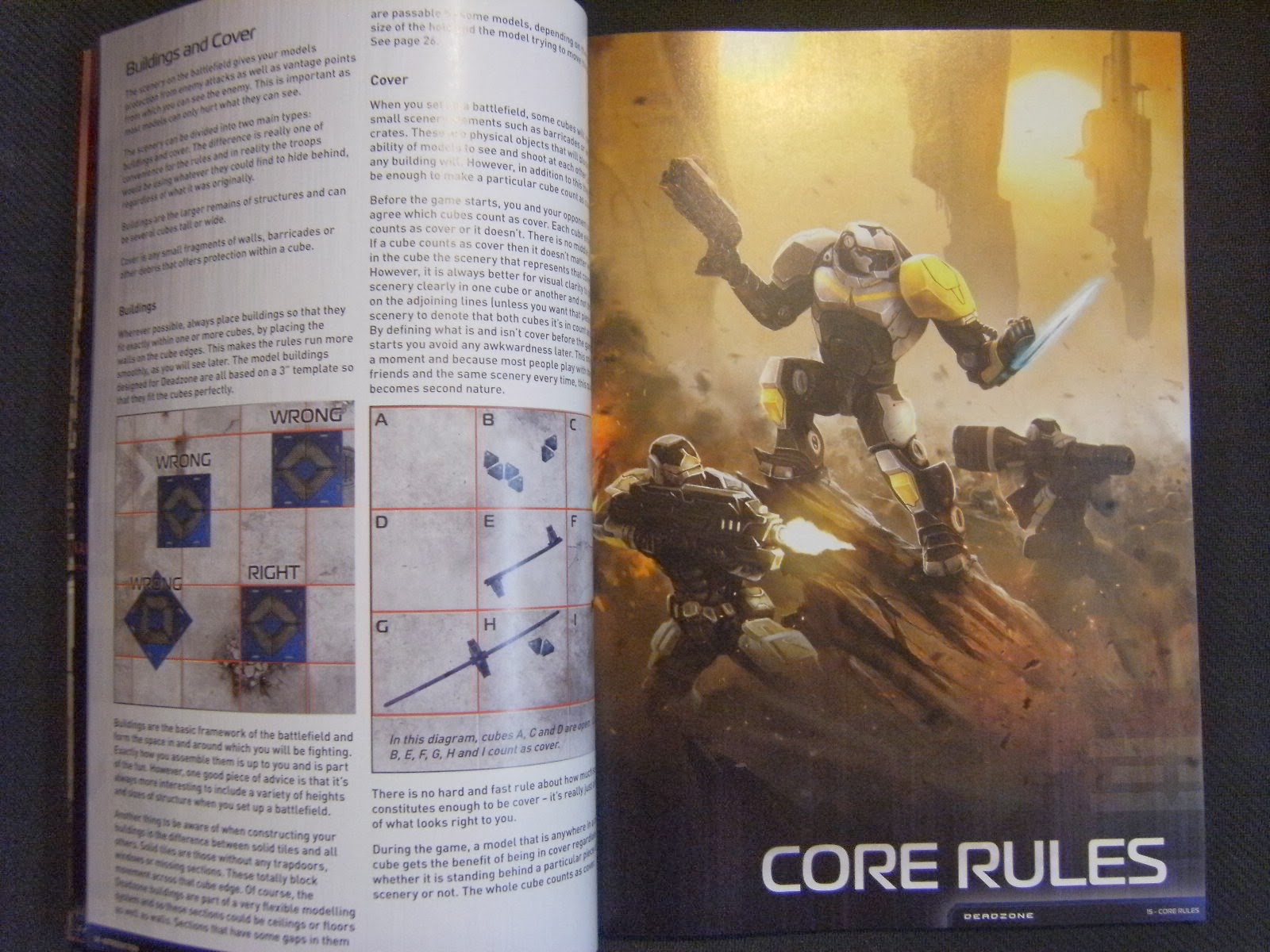
Seeing as we just mentioned the Sedition Wars rulebook we might as well take a moment to look at the pair of them.  Straight away Mantic have thrown down the gauntlet, with Deadzone's rulebook being very much a bound book in its own right.  The Sedition Wars rulebook by comparison is still sizeable, but doesn't have that same feeling of opulence when flicking through its pages.
 
Sedition Wars: She'd better watch where she's pointing that thing!
 
Deadzone: Cor! Rules!
Inside, both are of a similar nature, containing exactly what you'd expect from a rulebook.  Both give a rundown on the games' warring factions as well as a brief background to their respective universes.  The rules are obviously covered, and both include details for running campaigns if you fancied something more in-depth than a simple one time game.
 
There are still a couple of elements to follow, but we'll move onto the big one now: gaming pieces!
 
The many and varies bags of Sedition Wars.
The less many bags of Deadzone.
From a first impression, Sedition Wars does seem to take a lead over Deadzone in this respect, with the box featuring 50 miniatures to Deadzone's 23.  With both games having that tabletop element, these are provided unassembled and unpainted, with players needing to rely on their hobby skills to get them ready for action.  This does make the higher model count something of a double-edged sword, as it's great to have more toys to play with, but obviously means more prep-time is needed before they're ready to go.  Of course, Deadzone's scenery sprues will go some way to balancing this out.
The level of details on both sets of models is certainly very nice, but Deadzone claws some points back from Sedition Wars with regards to casting quality.  Whilst both will need some filing before assembly to rid the models of unsightly mould lines, those in Sedition Wars do feature considerably more flash which needs to be clipped off  before assembly.  This might not sound like much, but with 50 models to trim back we can bet it's going to be a time-consuming process!.
 
One of the things which made the comparison between the two games easier to draw was the nature of the models.  In both cases the factions seem to be split into futuristic human military on one side, and zombie-like genetic mutations on the other.  At the time of writing this article we haven't finished any models on either side yet, but the following stock images from both manufacturers show the finished quality on their respective miniatures...
 
Sedition Wars' Vanguard.
 
Deadzone's Enforcers.
 
Sedition Wars' The Strain.
Deadzone's Plague.
 
Some lovely models here on both sides.  From a personal point of view, we have to say we prefer the humans of Deadzone's Enforcers over those of Sedition Wars' Vanguard.  The stylised oversized heads and hands of the models has never been something we're fans of, much preferring the normal human scaling favoured in the Deadzone range.  However when it comes to The Strain vs Plague it's a much closer run thing!  With no scaling standard when it comes to genetic abominations, these figure ranges boil entirely down to the detail level in the castings, and as you can see above there's not much between them!  At a push we'd probably say we just about favour The Strain, but again that's personal preference entirely.
There are two further points that must be raised here, both in favour of Sedition Wars.  First of all, the bases included with its models are scenic, making the miniatures look as though they are standing on the decking of a ship rather than the plain smooth bases of Deadzone.  Secondly, the bases have handy little slots underneath them for clipping in plastic markers to signify status changes in the characters.  This is a very nice touch, and makes a refreshing change from having to place tokens next to miniatures or beside their character cards.  Kudos to Studio McVey for this simple, yet innovative idea.
 
The character cards of Sedition Wars.
The faction decks of Deadzone.
With any kind of system like this, sets of cards are usually a given.  In the case of Sedition Wars, stat cards are provided for each miniature, giving players a quick-reference guide to their stats and abilities.  With Deadzone it's a little different.  Both sides have a 54-card Faction Deck.  As well as statistics for each miniature, this deck also contains actions and objectives, mixing things up a little and giving an extra level of depth to the game.
 
Sedition Wars certainly isn't shy on the token front.

...but neither is Deadzone, come to that.
Both games feature a plethora of tokens, to signify all kind of weird and wonderful things (we could go into detail, but that would probably require a whole article to itself!).  More isn't necessarily better when it comes to tokens, so there are no points to be dished out there, but in terms of quality the tokens from Sedition Wars are printed on higher quality card, and so will probably take more punishment before starting to go dog-eared.  However, they are only printed on one side, which is unusual for game tokens, and so unless players are incredibly well organised it may be a nuisance trying to find the one you're after in a hurry.
 
The only unmentioned aspect of the box contents is the dice, as there's nothing particularly special about dice!  Sedition Wars works on a D6 system, and so contains 8 standard D6's, whereas Deadzone is based on D8's, so contains 6 of these.
 
To end this box contents comparison we will make a quick note on the actual box interiors, as these can be something of a sticking point for us, as mentioned when we reviewed Bioshock Infinite: The Siege of Columbia.
 
 
Sedition Wars doesn't feature the greatest box insert in the world, but there's something there at least, and it features the same artwork as on the box cover.  The channel down the centre is enough to contain the tokens and cards, although doesn't really provide much protection for the miniatures (especially once they've been lovingly painted!).  The raised sections to the side allow the boards and rulebook to rest snugly on top, so all-in-all Sedition Wars is designed to be carried around as a self-contained unit.
Deadzone on the other hand, is a plain white box on the inside (hence us not bothering with a photo.  There are no sections for keeping the cards, the dice, the tokens... anything, basically.  It's a sizable box, and if you were to attempt to carry it around then we wouldn't like to imagine the state your various game components would be in when you reached your destination.  It seems very much as though it's been designed to be discarded after opening, requiring the additional purchase of some kind of carry-case to make transport feasible.  Again, looking at this from a board gamers' perspective, it's a notch in the negative column for Mantic's new release.
 
So that's the box contents of these two mammoth games!  At this point it's difficult to say which of the two is coming out on top.  Sedition Wars boasts more miniatures, and there's not a great deal between them in terms of quality.  Deadzone's scenery looks set to give a more immersive gameplay experience, but Sedition Wars' modular gaming board allows for a decent degree of customisation.  Deadzone has the nicer rulebook, but Sedition Wars score points for including a box which can transport the game as a whole.
From this initial comparison we'd probably say that neither games is shaping up to be a superior overall product, but Sedition Wars is in the lead as far as being a self-containted board game goes.  With both systems looking very intricate it may be a couple of weeks before Part 2 of this comparison hits your screens, as we want to make sure we do both games justice!  If you've been lucky enough to get your hands on an early copy of Deadzone though, or have played Sedition Wars in the past, we'd love to hear your opinions in the comments section.  For now, take care, and happy gaming!