Showing posts with label sports. Show all posts

Sunday, 31 May 2015

Guild Ball - An Overall Sort-Of Review, Part 1: Team Lineups

Last year we mentioned a new tabletop system we were backing on Kickstarter, named Guild Ball, and a couple of weeks back we posted a brief article showing off the contents of our pledge after they'd arrived.  To summarise, we were extremely impressed with the components, and were left feeling excited about our impending first games.
Now in that article we mentioned that we wouldn't be reviewing the gameplay of Guild Ball, wanting to keep the focus of Games & Tea on out-the-box games, but frankly we were so enamoured with the gameplay that we couldn't resist putting together another article giving it our overall thoughts.
The reason we've never been interested in reviewing full tabletop systems over board/card games is that there are too many variables to go into - we like to talk about turn sequences, game components and so on, but when there's an infinite possibility of actions to choose from each turn, and the components are determined by the shopping habits and play style of each individual hobbyist, it can be a struggle to keep the article at a decent length!  As such this will be slightly different from our usual review format, and we hope you bare with us and still find it an enjoyable and educational read.


So for those who missed the Kickstarter, and missed our fanboy gushings over the game, and haven't seen it at the UK Games Expo (and so on and so on...), Guild Ball is a tabletop miniatures game which is half way between a sports game and a skirmish game.  It's set in the fictional Empire of the Free Cities, where the great guilds all play each other at the titular game - a medieval mob football style game.
The guilds are all based on areas of industry, and at the time of Season 1 there are 7 guilds to choose from; Butchers, Fishermen, Brewers, Masons (the Teamaster's personal favourites), Alchemists (the Tea Boy's personal favourites), Morticians and Engineers.  While not a guild, there is also the Union, which can be fielded as a team, but who's members are also free to play for a selection of the other guilds.

Each team consists of 6 players.  The captain and the mascot are both mandatory, and whilst we expect that later seasons will give us a selection, at this early stage in Guild Ball's life each guild only has one to choose from.  The remaining 4 places are where players get to customise their teams, and tweak them to match their preferred style of gameplay as they start to build up experience.
This is where Guild Ball stands out from the only other major sports-based game on the market right now - Dreadball.  It isn't simply a case of "These are your strikers, they kick the ball," and "These are your defenders, they stop your opponent from kicking the ball", each player has unique stats and abilities.  So instead you have "This is Harmony, she can do all of these wonderful things", and "This is Mist, he's basically Batman".  While the Union players are free agents and as such work as individuals, the guild-specific players all tend to have abilities to work off eachother.  In the Masons Guild, for example, the team starlet - Harmony - gets an armour bonus when close to their heavy hitter - Brick - as he's protective over her.  The team captain - Honour - gets an attack bonus when going after the same player as the mascot - Marbles.  Now this does mean that it will take a few games before any new players even begin to squeeze the maximum potential out of their lineup, but the trade off for this is that the team rosters have an incredible degree of flexibility, helping players to become invested in their chosen guild rather than having to go down the route of collecting multiple teams to get any kind of replay value from the game.


Just to give an example, here are two of the starting lineups for the Teamaster's Masons Guild.  The top team is pure Masons, and so there's a lot of synergy going on there.  In the bottom team, 3 of the players have been dropped out in favour of Masons-compatible Union players, so while the team no longer gels quite so well, it's now much quicker and favoured towards fast strikes.

At the point of Season 1, most guilds have 7 players on their own roster, with 4 compatible Union players to choose from as well.  So with the captain and mascot slots filled, this leaves 9 choices to fill the 4 remaining spaces, giving the players plenty of freedom to build a team to suit their style of play.
And speaking of style of play, how do they work?  Each player comes with a stat card, which tells players what they can do whilst at the same time allowing them to keep track of the damage done to that player...


The top bar of each card gives the player's stats, which come under 6 categories:

  • MOV determines their base and maximum move distance, so for example 6"/8" means they can jog 6" or sprint/charge 8".  The higher this number, the quicker the player.
  • TAC is the number of dice in their dice pool when attacking another player, so a higher TAC means a stronger attack.
  • KICK is the size of their kicking dice pool and the maximum kick distance, so 3/8" would mean an 8" kick range and 3 dice to try and succeed in that kick.  The higher these numbers, the better chance of scoring goals and successful passes.
  • DEF is the player's base defense, and is the target number an attacker must roll in order to hit the player.
  • ARM is the player's armour, and dictates how much damage is deflected before getting through to the soft and squishy player underneath.
  • INF determines how much influence the player generates, and how much they can be allocated.  So 2/4 means they'll generate 2 influence, but can be allocated up to 4.  We'll go into influence in detail in the second part of the review, but in a nutshell it's the currency used to perform almost any action.  Attacking, sprinting, passing, shooting - all of these require influence.
The Character Traits on the front of the card address any passive abilities the players possess, such as DEF boosts in the presence of other player, MOV bonuses, and so forth.  The bottom of the card shows the players damage boxes - once these have been depleted then the player is knocked out.
The rear of the card tells you their base size and melee range, the details of any activated abilities, and explains how they cause damage in combat.  Again, this will be further addressed in the next article.

Before we wrap this article up, we should also take a moment to talk about the quality of the miniatures, as this is a tabletop system and so the hobby element is a key part.


First of all, the sculpts themselves.  Long gone are the days of hunched-over Space Marines, shuffling awkwardly around the battlefields of the 41st Millennium.  These days, most miniature-based games do provide nicely detailed and dynamic models for hobbyists to enjoy.  Guild Ball is no exception, and in fact has left us salivating over some of the nicest models we've ever had the pleasure of owning.  The poses are incredibly dynamic for the best part, and even the ones which aren't don't feel disappointing.


In terms of casting quality and assembly, Guild Ball's quality shines through.  There's very little cleanup work required on the miniatures, with mercifully few mold lines and little to no flash on those we've built so far.  They also fit together very nicely, and don't generally require the fine tools of a NASA engineer and the steady hands of a neurosurgeon to assemble them correctly.  The only criticism we'd put forward is that the blisters include character artwork, but not an image of the built miniature, so we have on a couple of occasions found ourselves wondering where pieces go.  In fact one of our Union models - Snakeskin - came with a dagger sheath which ended up in the spare bits box, as it didn't have an obvious place to go and the model seemed complete without it!


So that's all we really have to say on the subject of the teams.  The model quality is astounding, the player lineup happily full of variety, and the synergy throughout the teams works to give Guild Ball an excellent learning curve.
Tune in for the second half of the review, where we'll talk about the gameplay, including how that influence works, gathering momentum, and the consequences of beating an otter into unconsciousness.

Sunday, 23 February 2014

DreadBall Xtreme Now On Kickstarter!

Back towards the end of last year, we brought to you our thoughts on Mantic Games' tabletop/board game of futuristic sporting action: DreadBall.  We had very positive things to say about the game as a whole, and one thing we mentioned was that it had a bright future ahead.


Well Mantic have gone and turned up the wattage on this bright future, dazzling us with their latest addition to the franchise; DreadBall Xtreme.  The core DreadBall game is set in the highest echelons of the league game, with vast stadiums, multi-million credit players, and stands full of adoring fans.  Xtreme, on the other hand is set to bring DreadBall down to a grittier level.  To describe it as "grass roots" DreadBall would be a start, as long as you were willing to go past the roots, through the topsoil, and down into the dark, dank underground of the sport.

Whilst original DreadBall teams will be compatible with this new version, Xtreme features some major changes to the original format, including a lack of referee (meaning fouls/murder are now an accepted part of the game), a customisable play area (so scoring zones and launch areas are no longer a constant), and sponsors to pull the strings behind the scenes!

DreadBall Xtreme is currently open for funding on Kickstarter, so for further details and if you wish to pledge, click here.  $75 (including shipping to the UK and US) will get you a copy of the boxed game upon it's completion, which consists of 2 teams (including 2 prone players for each side), 2 Sponsors, 9 Free Agents, 4 Strike Posts, Scenery Crates, Dice, Cards, a Roster Pad, Rulebook, and 2'x2' Deluxe Pitch.  A $150 pledge will get you a host of Kickstarter exclusives, and from there the sky's the limit, with pledges going all the way up to a whopping $5000!

Funding for DreadBall Xtreme closes on March 16th, and whilst it has already met its funding goal, going in for the Kickstarter bundles will give you more bang for your buck than waiting for the store release.  Mantic's current shipping estimate is November 2014, and we're certainly looking forward to seeing how this is going to play!

Thursday, 19 December 2013

DreadBall Deluxe, Part 2: Gameplay & Verdict

Last week we stepped back into the world of board game/tabletop system hybrids as we took a look at the box contents for DreadBall; the futuristic sports game from Mantic Games.  Today we're going to run our two teams out onto the pitch and find out just how well it fares as a standalone board game, or if it should be confined to the collections of tabletop hobbyists.


The DreadBall starter box comes with two teams: The Trontek 29ers and The Greenmoon Smackers.  Of course players can paint their miniatures up in the default colour schemes and use these exact teams, but it's always good fun to come up with your own ideas, giving a little more personal investment in the 8 brave warriors of the sport who are being pummelled for your own amusement.  With this in mind our DreadBall Deluxe boxset has given rise to two new giants: The Cybertron Sentinels and The Arkham Outcasts!

The Cybertron Sentinels!

The Arkham Outcasts!  Okay we've only painted one so far, but orange is time-consuming, okay?
Both teams have a very different set of attributes which result in very different gaming experiences (which we'll come to in more detail later), so once players have decided which team they'll be fielding, it's time to set up the board.


Board set-up in DreadBall takes mere seconds, which is very refreshing when you look at many specialist board games on the market.  Once the board is opened up the score marker needs to be placed on the '0' point of the score track (shown along the bottom side of the board above), and the turn marker needs to be placed on '01' on the turn track (shown along the top side).  This concludes board setup!  Doesn't that make a lovely change?

Players must then decide who will be fielding the home team, and who will be the visitors.  This is decided randomly, so can be done either by dice-rolling or by one player randomly selecting the Home Fans or Away Fans card.  The home team will set their team up on the blue side of the board and use the blue dice from the set, with the away team following suit on the red side and with the red dice.  You may notice that the turn track is coloured to match these sides - this is because the home team always takes the first turn in DreadBall, after which play alternates until the final turn is played by the away team (unless one team has romped home with a 7 point clear victory before then).  Both teams also start with one coaching dice (a white dice), and one randomly-dealt card from the deck.  The remaining deck is placed face-down at the side of the board, and the remaining white dice placed to one side as well - these will be used to determine the referee's rolls when she's called upon to settle a dispute!  The number of starting cards and coaching dice varies from one team to the next across the DreadBall hobby, but the two teams in the balanced starter box begin with one of each.  Fair's fair after all!

The two teams each consist of 8 players, but the Deluxe box comes with an added bonus: two more players for each side.  This basically gives the players the options of customising their lineups a little, tailoring to more aggressive gameplay or allowing for speedier hit-and-run style strikes.  For new players though it's best to start with the basic lineup, and the rulebook contains the starting player lists for both of the featured teams.

There are three types of players in DreadBall: Guards, Strikers and Jacks.  All three of these feature in the 29ers, but the Smackers only contain Guards and Jacks.  A Guard is a big bruiser of a player, unable to pick up the ball themselves but good for Slamming (the DreadBall equivalent of a tackle) opposing players and causing some serious injuries.  Strikers are the nimble players who score most of the points.  They can't Slam, but can throw like demons and are great at dodging those hard tackles.  Jacks don't specialise in any one area, being able to Slam and take possession of the ball.  They're not as good as Guards or Strikers in their respective fields, but an all-rounder can be helpful when the time is right!
The Trontek 29ers team is quite Striker-heavy, meaning that it's a good team for making swift runs into the opponent's half to score those vital points.  The Greenmoon Smackers, on the other hand, have much tougher Guards and in greater number, which makes them a team best suited to knocking down your opponent's players, leaving an empty pitch for the Jacks to work their scoring magic on.

Of the 8 players in each team, only 6 are allowed on the pitch at any one time.  These 6 must be set up inside their respective halves before the game begins, with the 2 remaining players starting on the substitutes' bench.  DreadBall is a very physical game, so don't worry, they'll be on the pitch with their chance to shine before you know it!

Steve Batman of The Arkham Outcasts shakes a threatening fist at Megatron and the rest of The Cybertron Sentinels!
Once players have set up their teams and the ref-bot has been placed on her starting space, it's time to launch the ball and begin the game!

Each turn in DreadBall is referred to as a "Rush", and Rushes alternate between players.  This means that you don't have to worry about your opponent messing with your best laid plans during your turn, but it also means that by the end of your turn you need to have your players positioned and prepared for anything your opponent may throw at you during their Rush.
In a player's Rush they may take up to a total of 5 actions, and they can keep track of these using their player tokens.  In addition to this 5 action limit, each individual player on the team may only take up to 2 actions, which is a good way of preventing a player from heaping actions onto a single member of their team and dashing across the field to score easy points!  That said, lucky dice-rolling can reward players with free actions which do not count towards either of these limits, which can allow moments of sporting heroism to creep into the game.  Indeed, in one of our review games we had a player jump off the subs bench and sprint the full length of the pitch to score the game-winning points in a move worthy of any inspirational sporting film!
On top of these, cards can be played to give players further free actions, or can even put an ongoing effect into play which can affect the entire flow of the game.
A player's Rush ends when they have no further action points to spend, or when they lose possession of the ball, either from a missed shot, a failed attempt to pick up the ball, or a fumbled catch.  When this happens the turn immediately moves along to the other player, regardless of how many action points the active player had remaining.

Actions can include the likes of movement, Slamming, picking up the ball, and throwing it as either a pass or attempt to score.  DreadBall mostly operates on an easy-to-remember 3D6 system, so to find out if your action has been a success then you must roll 3 dice against your player's relevant stat (speed/skill/strength) and add up the number of successes.  If you do especially well at that action then it often leads to a free action and the chance to capitalise on your success, whereas a failure at an action can put you on the back foot and leave you having to rethink your entire turn.   This does let the random element play a large role in DreadBall, but both players are in the same boat on this front, and victory will usually go to the player who can best adapt their plans when the dice gods heap them with misfortune!
Whilst the system is usually 3D6, there are various modifiers which can increase or decrease the dice total.  For example a Guard excels at smashing their opponents, so they roll one extra dice when Slamming.  Strikers, on the other hand, are nimble, so they gain an extra dice when throwing, catching, or dodging a Slam.  If the throwing player is adjacent to one of the front 3 sides of an opponent's base then that throw becomes trickier to pull off, so they roll one less dice.  Then there are the coaching dice, mentioned earlier, which are earned through exciting and crowd-pleasing behaviour, and can be added to any dice roll to improve the odds off success.
These modifiers may seem hard to keep track of at first glance, but they do make logical sense when picturing DreadBall as the energetic sport it's meant to be, and after a couple of games the dice-rolling becomes second nature, and the gameplay quickly becomes very fluid.

The Cybertron Sentinels' No.8 Striker - Rumble - goes for a 2 point strike!
In spite of its violent nature, DreadBall is ultimately a sports game, and so victory lies in scoring more points than your opponent.  Each side of the pitch has 3 highlighted scoring zones.  The two zones closest to the half-way line are worth 1 or 2 points each (the higher score for the longer-distance throws), and the zone furthest into each player's half is worth 3 or 4 points.  The scoring system in DreadBall works on a slider, so if your opponent is 2 points ahead and you score a 3 pointer, you go into the lead by 1 point.  If your opponent then scores 1, the score resets to 0.  If one side reaches 7 points then they win the game outright, otherwise the team in the lead by the end of the 14th Rush is declared the victor!

This covers the basics of DreadBall fairly neatly.  There are more subtle nuances and additional rules which we haven't gone into here in order to keep this article at a readable length, so to experience them first hand you'll just have to take a trip to your FLGS and find out what all the fuss is about!

So just how does DreadBall Deluxe work as a board game, rather than an introduction to a gaming system?
Well obviously there is the building and painting element to the game, so this may put off potential players who don't have the tabletop feather in their hobby cap.  However, construction only takes a couple of hours and with a simple colour scheme a fully painted team can be quickly accomplished - whilst we are labouring slowly over Arkham Outcasts, the Cybertron Sentinels took us just one night to paint the entire team.
Unlike some board game/tabletop crossovers, DreadBall does come with everything needed to play the game in the box, although this is where the Kick-Off and Deluxe boxes differ.  Kick-Off contains the two teams of 8 players, the pitch, a basic rulebook, a single ball and two sets of dice.  Deluxe contains those two extra players for each team to add a bit of variety, and a spare ball just in case the first one falls foul of a vacuum cleaner or some similar menace.  It also includes the full rulebook, including rules for running leagues, the ref-bot, the DreadBall cards, and the extra set of dice.  These differing box contents both allow DreadBall to be played as a stand-alone board game straight out of the box, but obviously Deluxe gives a more complete experience, as well as being the better starting point for players wishing to take up DreadBall as a system rather than just a board game.  Mantic have released an expansion kit, however, so if players wish to upgrade from Kick-Off to Deluxe then they can buy this pack to add all of those additional parts to their collection.
As a game, DreadBall is quick to learn and smooth to play, with the 3D6 system taking very little time to get used to.  The different nature of the two teams allows for a bit of variety in gameplay - the speed and scoring prowess of the human team versus the brutal nature of the hard-hitting orcs - which is further added to with the Deluxe sets extra players, giving a degree of customisation to the starting lineups.  The fact that DreadBall is based on dice rolling does mean that random chance plays a role in events, but spread across 14 turns this usually balances out, and with some tactical adjustment and on-the-spot thinking the unluckier moments can be turned around fairly effectively.

One slight criticism of the set is directed firmly at the rulebook.  During the learning process for any game, referring to the rulebook is a frequent occurrence, and so most games come with a quick reference guide, or at the very least an index.  DreadBall comes with neither of these, and so any rules queries during those first couple of games do require some furious flicking back and forth between pages.  Mantic have spotted this shortfall to their credit, and the Season 3 rulebook contains a quick reference card at the back of the book, outlining the modifiers for each dice roll, and the outcome.  Unfortunately we're looking at DreadBall as a standalone game, and so this counts against them in the grand scheme of things.
The other downside to the game is that it's firmly for 2 players, so doesn't work as a group game on large games nights.  Again, Mantic have addressed this with the release of the chaotic DreadBall Ultimate expansion, which allows for up to 6 teams at once, but as a standalone board game Kick-Off/Ultimate doesn't benefit from this.

The Good Points
  • DreadBall features a fairly simple mechanic, but which is offset by enough modifiers to allow for a tactical element to the game.
  • The starter box comes with everything needed to get going with the game, rather than "almost everything" as some board/tabletop hybrids favour.
  • The two featured teams are different enough to create differing tactical challenges, and the additional players in the Deluxe box allow for a nice variety in the team listings.
  • Assembly time on the miniatures is mercifully short, and once built it's always fun to come up with names and themes for your very own teams.
The Bad Points
  • The DreadBall rulebook really could use a quick reference card, and beginners' games will be slowed considerably by the number of return visits to the rulebook.
  • Without investing in the additional Ultimate expansion, DreadBall is for 2 players only, preventing it from being a large, social game.
  • The idea of having to build and paint the miniatures may put some potential players off.
Recommended Number of Players: 2
As mentioned, DreadBall can only be played by 2 players, so this is a requirement rather than a recommendation.

Average Game Time: 60 minutes
Whilst some games of DreadBall can flash past in the blink of an eye due to some lucky dice rolls and top-notch player placement, most games run for the better part of an hour.  The 14 Rush cap on the game generally prevents play from going on much longer than this, so DreadBall is one of the games on the market which mercifully does not drag.

Replay Value: High
DreadBall is a fast and furious game, and does leave players wanting more.  Whether it's a desire for revenge against a crushing defeat, or the hope to recreate a dazzling victory, the DreadBall pitch does generally call players back.  The ability to vary the lineup and surprise opponents with cards in the Deluxe set add to the replay factor, and the chance to switch between teams for different tactical challenges help to keep the game from stagnating.

The Future: Bright
Being a tabletop system as well as a board game, there is a lot of DreadBall on the market for players wishing to expand their playing options.  In addition to the two featured in the box, there are 10 other teams which can be purchased seperately, as well as star players which can be used to boost existing teams.  On top of these there's also the DreadBall Ultimate expansion, turning the game into a group event for up to 6 players.

Price: £50 Deluxe (£30 Kick-Off)
The DreadBall Deluxe boxset will set you back roughly £50, which is starting to get towards the top end range as far as board games go.  Kick-Off, on the other hand, is a more pocket-friendly £30.  It should be noted that both sets give good value for money, so it really boils down to how far players want to take the plunge into the world of DreadBall.  Most gaming stores should stock it as a standard item, being a main system from one of the big names in tabletop gaming, but even if they don't keep it on the shelves it should be easy to order in.


OVERALL SCORE (DELUXE): 9/10
OVERALL SCORE (KICK-OFF): 7.5/10

Tea consumed during this review: None! Douwe Egberts caramel coffee with milk and 2 sweeteners. Brew rating 9.5/10
 

If you enjoyed this article and want to see more of the same, come and like us on our Facebook page to keep up to date with our reviews, as well as our general day-to-day ramblings!

Friday, 13 December 2013

DreadBall Deluxe, Part 1: Box Contents

On a couple of occasions this year we've taken a look at games which cross the threshold between board games and tabletop systems.  First we threw in our two cents worth on Wyrd Miniatures Puppet Wars Unstitched, then we picked up the currently-on-hiatus Sedition Wars from Studio McVey and Deadzone from Mantic Games.  Continuing with this trend we're now turning our spotlight onto another one of Mantic's offerings, but this time of a very different nature, as we look at DreadBall; the futuristic sports game by Jake Thornton.
 
 
DreadBall is a game for 2 players, and is set in the universe of Mantic's tabletop system Warpath.  There are two different starter boxes which can be purchased for this game: DreadBall Kick-Off and DreadBall Deluxe.  For the purposes of this review we're going to be taking a look at Deluxe, as it gives players the complete DreadBall experience, whereas Kick-Off gives something of a stripped-down version, still playable in its own right, but lacking some of the finer points of the whole game.  At the end of this review we'll point out the elements which only come with the Deluxe set, allowing you lovely folk to decide which version better suits your gaming habits and pockets.
 
The initial appeal (after seeing how many people at our FLGS were enjoying the system) of DreadBall to us was its nature as a sports game.  We're not exactly the biggest sports fans in the world, but when most tabletop/board game hybrids are about two opposing forces trying to shoot eachother to death, it was a breath of fresh air to see something a little different.  In our Christmas gift guide we mentioned that our first impression of DreadBall was a combination of American Football and the assorted games of the Tron universe.  Having now played the game we can confirm that this is fairly accurate, although with the brawling element of ice hockey thrown in for good measure!  Let's have a run through of the box contents, and you can see exactly what the Deluxe box gives you to run rings around your opposition!

 
As usual, we'll start things off with the board.  Unlike some of the previously mentioned tabletop/board game hybrids, DreadBall does actually feature a good old-fashioned gaming board.  Any sportsball game by its very nature is played within a clearly defined area (we're lead to believe that sports buffs know these as "pitches"), and so the DreadBall board lays out the pitch for this adrenaline-fuelled encounter.
The pitch is divided up into hexagonal spaces, which neatly fit the hexagonal bases of the miniatures.  Making sure your players face the right direction is an important part of a match, and by opting for hexagons Mantic have given a decent range of facing and movement options.  As you may have guessed, the aim of the game is to score more points than your opponent's team, and so the blue and red areas of the board are the scoring zones for the home and away teams.  Other areas of the board include both teams' substitute benches and sin bins/recovery areas (DreadBall is the very embodiment of a contact sport after all!), the scoring track, and the turn counter.
 
 
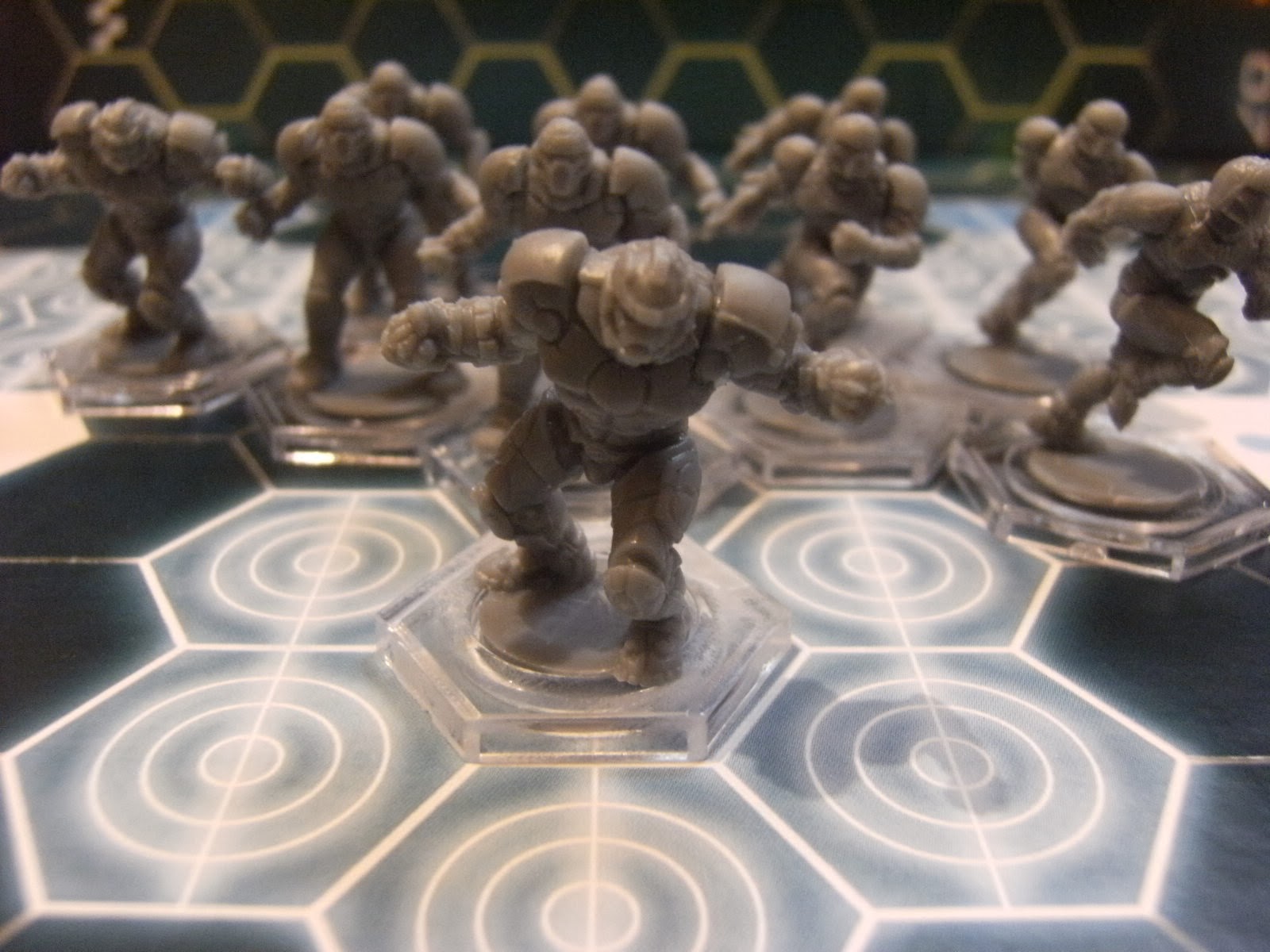
In order to play any sportsball game, teams are fairly essential.  The DreadBall boxset contains two teams: one of humans - The Trontek 29ers, and one of marauders (orcs, to you and me) - The Greenmoon Smackers.  As usual in tabletop/board game hybrids, these do require assembling and painting, but they do go together with very little hassle and we had both of our teams ready to go within 2 hours...


Obviously painted miniatures do look a lot nicer, but if you're anxious to take to the field then there's nothing to stop players from using unpainted models.  Just make sure you wait for the glue to dry so that you don't ruin your nice game board!
 
Of course a sportsball game wouldn't be a sportsball game without... well... a sportsball!  And it would quickly descend into chaos without some kind of official to keep watch over the proceedings...
 
 
Fortunately DreadBall hasn't overlooked these points, and the Deluxe boxset contains a pair of balls (stop sniggering in the back row) and a ref-bot.  The ref-bot is not just included for aesthetics, but actually follows the action around the board and officiates over disputes.  The ref-bot not only has the power to send players off or sin-bin them for a number of turns, but it can also be used sneakily to block your opponent's team from getting to the ball or stomping a downed player!
 
 
We've grown used to board games throwing a plethora of tokens our way, and so the stunning lack thereof in DreadBall was initially a cause for great confusion.  On reflection, however, there isn't really much in a sportsball game which would need to be marked out with tokens, and so the box contains just a small sheet.  Each player can take 5 actions during their turn, and so each team has 5 tokens used to keep track of these.  Aside from those, there are simply a pair of tokens to keep track of the score and turn number, and one card effect marker.
Also included in the box is a decent set of dice in three different colours - blue for the home team, red for the away team, and white for the ref and to be used as coaching dice, which can be earned with flamboyant gameplay and used to bolster other dice rolls during a match.
Once you've selected your team, you might want to keep a record of their achievements, and so a team roster pad is also provided.  This is really only relevant for ongoing league campaigns rather than one-off matches, but if (like us) you decide to give your chosen team a theme, then you might want to fill out the roster to keep track of your players' names just for fun.

 
A game of DreadBall is a fast-paced and dangerous thing, and even the best laid plans and tactics can fall apart in the face of the whimsical sportsball gods!  DreadBall comes with a single deck of cards which can turn the tide of the game and maintain the unpredictable nature of a match.  Some of these cards have ongoing effects which stay in play until replaced by another, whilst some are one-shot uses which can have a devastating effect if played at the right time - having the ball explode as your opponent is about to throw a winning strike is always cruel!  As well as these effects, the cards also serve two other purposes: determining the movement of the ref-bot, and tracking how happy your fans are!  Pleasing your fans earns coaching dice for your team, which can help to score all-important points, which in turn make your fans happier still!
 
 
And of course it's generally useful to have a rulebook, otherwise the box would just be a mass of confusing components!  The full-colour DreadBall rulebook is rather nice, and features the complete set of rules for the game (the smaller book in the Kick-Off box only contains a stripped-down version of the rules - this will be further explained in Part 2).  As well as a breakdown of the gameplay, the rulebook also contains the stats for the different races' teams (including some of the additional teams, available to buy separately), and guidelines on how to run a league campaign with friends.

All in all we certainly felt satisfied that we were holding a quality product when we cracked open our DreadBall Deluxe box, so come back next week to find out what we thought of the gameplay, how the Kick-Off box compares, and the themes we eventually chose for our two teams!