Showing posts with label zombies. Show all posts

Monday, 28 April 2014

Zombies Keep Out, Part 2: Gameplay & Verdict

In our last article we headed back to the much-beloved world of zombies, taking a look at the box contents for Privateer Press' new release, Zombies Keep Out - a co-operative game for 1-6 players.  Now it's time to have a good look at the gameplay mechanics, and reward it with its coveted* Games & Tea final score (*Games & Tea final score may not actually be coveted).
In Zombies Keep Out, players take on the roles of the Bodgers - a team of tinkering goblins who find their workshop under siege from an approaching zombie horde.  The players must work together to fend off the zombie horde and cobble together 3 contraptions to stop them, before the zombies overrun the barricades and swarm through the workshop!
The zombies' shambling routes are arranged into nice neat columns (whoever said zombies are messy?), with the zombie pool at the bottom of the board and the workshop along the top.  To begin the game, the bottom two rows are filled with zombies, with one in each space.  There are four different types of zombies - Creepers, Leapers, Brutes and Runners - each of which are colour-coordinated with a certain area of the workshop.  The initial setup zombies are placed to match up with their corresponding locations, so the cellar (far-left) is faced with yellow Creepers, the front doors (centre) with a pair of red Brutes etc.  With the zombies places, the initial barricade tokens are placed on each workshop location, giving the Bodgers' stronghold a decent headstart over the horde.  Then a face-down contraption card is placed next to each workshop location, initial part cards are dealt out to the players, and then you're ready to go!  This is a nice, short setup sequence, meaning that players won't be left waiting for mountains of game components to be sorted and shuffled.
The player most prepared for a real-life zombie outbreak goes first - which in a crowd of zombie fans can lead to some arguing before the game even begins!  Once the argument has been settled (trial by combat is a favoured way of resolving things), the game can finally begin as the zombies get underway!
The first phase of each player's turn is dedicated to the zombies, as the active player draws a Terrible Things card off the top of the deck.  The Terrible Things cards throw new ever-changing challenges the players' way, ranging from minor annoyances to flat out disasters!  Terrible Things include adding to the number of active zombies on the board (as in the example above), moving zombies, backtracking on an in-progress blueprint, discarding all-important parts cards, or getting bitten (which is one of our favourite mechanics, and will be mentioned in more detail later!).
Each Terrible Things card contains three options, and the player must choose one of these actions to go ahead with.  Once the action is chosen, the player discards the card face-down and carries it out.  The rejected options are never revealed to the other players, which is a nice minor rule to keep players from second-guessing eachother.  The chosen action must be possible however, so a player wouldn't be able to choose a "All zombies in the rear row shamble forward" option if there were no zombies in the rear row.  In the event of none of the options being possible, then all zombies on the board advance!
Whilst there are four different zombie types, Privateer Press have kept things simple in terms of movement, and each zombie only moves one space when prompted.  The zombies always follow the path of the appropriately-coloured arrow, so the grey Runners always shamble straight forward, whilst the Creepers, Leapers and Brutes do their utmost to head towards the matching area of the workshop.  Now moving one space at a time may seem quite harmless and manageable, but once the zombie numbers begin to rise, chaos can ensue!
Each space can only contain a maximum of 3 zombies, so if there are ever any more than that, the active player must shamble some of them further on until only 3 remain.  Of course, this can have a knock-on effect of causing further spaces to exceed their zombie limit, and further shambling is called for!  In worst case scenarios, a simple shamble can cause a butterfly effect which brings the whole workshop crashing down!
"Avon calling..."
If a zombie needs to shamble whilst in the final space of a column, they deal damage to the barricade and are returned to the zombie pool, and this is where strategic zombie-placement comes into effect.  The grey Runners only ever deal 1 point of damage to their target, but if any of the other zombie types ever hit a section of the workshop which matches their colour, it deals 2 damage instead.  If an area of the workshop ever loses its final barricade token, it's considered to be overrun, and the contraption behind it is removed from play, and any further damage which would be dealt to that section is instead dealt to the next section across in the direction of the central doors.  If the doors are ever breached, or three of the contraptions are destroyed, the zombies have overwhelmed the workshop and the players lose.
Once the Terrible Things card has been resolved, the player then takes their action for the turn.
We'd just like to pause at this point to make a small note about the turn sequence.  We think it's a bloomin' good sequence!  Most zombie games involve the player taking their turn first, and then the zombies activating afterwards.  By reversing the process in Zombies Keep Out, players are given the chance the react to the unfolding events, rather than being left on the sidelines for a round until the turn passes back to themselves.  It may only seem like a little thing, but it makes a lot of difference to the way the game feels.
Anyway, moving swiftly on to the players' actions.  During each turn the player may only take one action out of five possible choices.  Three of those options revolve around the part cards, so this seems as good a time as any to take a closer look at them.
There are three sections to each parts card, relating to the three possible actions for which they can be discarded in exchange.  To use the card to Defend, the player selects one space on the board and can remove a zombie of the specified colour, returning it to the pool.  The card above is a versatile one, allowing the player to kill any of the zombie types.  Some are more limited in their zombie-killing options, whereas others may restrict players to one zombie type, but allow them to kill two of that zombie instead.
To carry out a Repair action, the player can add a number of barricade tokens equal to the number shown to any location in the workshop, as long as they don't exceed the starting number of barricades.
To Tinker, the symbol on the parts card must match the next symbol along on the blueprint track of any contraption card.  If it matches, the progress counter can be moved one space along the track.
Once the progress counter reaches the final space on the blueprint track, the contraption is complete, and it can be put to use on subsequent player turns.  The one and only win condition for the game is to complete three of these contraptions, so good hand-management is key to victory.
Which brings us to Push The Button actions.  When a contraption is complete, a player can take a Push The Button action to activate the contraption during their turn.  Contraptions have a range of effects, from allowing players to draw extra cards, to allowing them to destroy zombies without having to discard.  Completing a contraption at the right time can turn the tide of battle!
And then the final action is simply to Scrounge, which allows players to draw two extra parts cards.
In addition to their action, players may also trade cards with eachother, ensuring that the correct parts come up when needed.
Once the player has taken their chosen action, play moves onto the next player, and another Terrible Things card starts the ball rolling again.
So that just leaves biting!  The bite rules were one of our favourite things about Zombies Keep Out, so we'll go into them in a little more depth here.  The only way players can get bitten is as the result of a Terrible Things card, and upon getting bitten they receive a bite token.  If at any point every player has at least 2 bite tokens, the game is over and the zombies have won (but seeing as the players are turning into zombies anyway, it's a win-win situation really).  The number of bite tokens a player has reduces their action options, but the rules about behaviour are the most fun!
After one bite, players can no longer trade cards, and must slur their speech for the rest of the game.
After two bites, they can no longer tinker either (picture a mindless player who can only bash things and nail up planks of wood!), and their speech must become barely intelligible.
After three bites, they can no longer use speech at all, and can only communicate through grunts and hand-gestures (imagine the fun of trying to teach the game to new players at this point!).  Also the player has to choose their Terrible Things option before even looking at the card, by grunting and holding up the appropriate number of fingers before drawing it.
And after four (or more) bites, the player has fully turned into a zombie!  They can only communicate through zombie noises, and instead of taking an action in the second phase of the turn, they draw a second Terrible Things card instead!
And that's the basics of Zombies Keep Out.  It's not the most complicated game by any means, but is a nice casual take on the zombie board game genre.  The quick setup time and small board mean that it's an easy game to get out, play through, and put away again, making it a nice way to break up a long gaming session.  It's also quick to learn, and within a few minutes of our first session everyone confidently knew what they were doing.  Being a casual game, it does create a very good atmosphere with like-minded friends, but this is where the issues with Zombies Keep Out start to arise.
It's a good social game, and the bite rules are fun for those who have been bitten and entertaining for those who are watching, but the flipside of this is that the overall experience begins to diminish as player numbers decrease.  When you're only playing with 2 players, for example, and one player gets bitten, it becomes less fun for the healthy player as they no longer have a coherent teammate to communicate with.
The solo game suffers from the same setback, as you're left trying to play a social game without the social element.  There are many cooperative games on the market which can be played solo - some, such as Firefly, work incredibly well, and some, such as Arkham Horror, are a masterclass in futility as the game mechanics fail to translate to a single player.  In both of these cases however, you're still left feeling immeresed in the game, whether scraping together a living as a planet-hopping transport captain, or struggling against an unstoppable tide of eldritch horrors.  With a solo game of Zombies Keep Out, you aren't left feeling like you're boldly taking on the army of the undead single-handedly, but instead feel more like you're playing a game of solitare - simply hoping you draw the right cards from the parts deck for the blueprints in front of you.

Solo will not be needed for this game...

And finally we should touch on the replayability, of which there isn't a great deal.  It's certainly a fun little casual game, but there isn't much going on to make one playthrough different to another.  Sure, you don't know what the next Terrible Things card might yield, but when they all serve roughly the same purpose - and the entire deck is cycled through once per game anyway - repetitition creeps in fairly quickly.
So is this the zombie game we've been dreaming of to keep our undead fandom satisfied?  Alas, no.  But at the very least it's a nice little casual game which will tide us over until the next contender steps into the ring.
The Good Points
  • Zombies Keep Out is quick to set up and easy to learn.
  • Up to 6 people can play at once, so it can accomodate a decent-sized gaming group.
  • The bite rules lift the game up a notch, so as long as the group is willing to play along it creates a very fun atmosphere.
  • The box and board are relatively small, making it an easy game to transport and play.
The Bad Points
  • There's not a great deal to mix things up between playthroughs, and replayabilty suffers as a result.
  • Being a social game, a lot of the atmosphere is lost with fewer player numbers, and solo mode verges on becoming a drag.
  • Some variety in the zombie miniatures would have been nice.

Recommended Number of Players: 4+
Zombies Keep Out is a textbook "the more, the merrier" game.  The atmosphere doesn't hold up well with 2 players, and whilst 3 is a step in the right direction it's still not great.  6 players works very well, but anything above/including 4 should make for a decent session.
Average Game Time: 45 minutes (30 minutues solo)
For a casual game, Zombies Keep Out has quite a decent play time.  At 45 minutes, you're unlikely to be playing it more than once in a single gaming session, which is actually a good thing as it extends the game's otherwise meagre lifespan
Replay Value: Low
Whilst it's fun laughing at the grunts and frustrated hand gestures of your infected teammates, this isn't enough to hold up Zombies Keep Out by itself.  It's a nice little game for the first couple of playthroughs, but following on from that it becomes stale and repetitive, with nothing really to keep it refreshed.
The Future: Shambling
Zombies Keep Out is a new release, so the future is quite open at the moment.  The first expansion is already on the horizon in the form of Night of the Noxious Dead, but to be honest it doesn't look like it'll be enough to breath life into the core game.  The expansion features a new zombie type, new contraptions, new Terrible Things and new parts, but on the whole it looks like it's going to be more of the same, which isn't going to help an already samey game.
Price: £25
Zombies Keep Out will set you back around the £25 mark.  This is a decent price for a board game, but has to be weighed up against how much replayability you'll be getting out of it.  Being a new release from a big name in the miniatures world, it should be fairly easy to track down at your local gaming store if you fancy taking a chance on it.
OVERALL SCORE: 7/10
Tea consumed during this review: Typhoo, milk and 2 sweeteners. Brew rating: 7.5/10


If you enjoyed this article and want to see more of the same, come and like us on our Facebook page to keep up to date with our reviews, as well as our general day-to-day ramblings!

Sunday, 27 April 2014

Zombies Keep Out, Part 1: Box Contents

We've mentioned (more than once) in the past that zombies hold a special place in our hearts here at Games & Tea, and as such there is no shortage of zombie games in our collection!  With zombies as popular as ever though, it seems that a new zombie game is getting released every other week, and it can sometimes be hard to separate the quality from the chaff.  So far we've taken a look at Zombie Fluxx, which we thoroughly enjoyed (although Fluxx isn't everyone's cup of tea), Zombies!!!, which we found clunky and very repetitive, and the yet-to-be-reviewed Zombicide, which seemed to be using a lot of fancy components to hide a lack of depth.  Now Privateer Press have thrown their hat into the zombie ring with the latest game in their Bodgers series: Zombies Keep Out, a cooperative board game for 1-6 players.
 
 
Privateer Press are perhaps best known for their Warmachine/Hordes tabletop systems, but are no strangers to the world of board/card games.  The light-hearted Bodgers series always centre around a team of goblins, and the different games all have separate themes, with the theme of Zombies Keep Out obviously being the undead.  It's not a game that takes itself seriously, as evidenced by the box art, so if you're looking a gritty, immersive survival horror game then you're probably best leaving now.
The players take on the role of the Bodgers, who have barricaded themselves in their workshop in reaction to a zombie outbreak.  As the zombies advance on the workshop and attempt to tear down the barricades, the Bodgers must rely on their resourcefulness and mechanical skill to construct 3 devices to fend the undead horde off.  Part 2 of the review will go into how this works in detail, so for now let's take a look at what you'll find inside the Zombies Keep Out box.
 
 
The Zombies Keep Out box is very nice and compact, and in fact is the smallest box for a board game in our substantial collection.  As a result, the board itself is also quite small, requiring only a small amount of set-up space to play.  The board shows the front yard outside the Bodgers' workshop, with the numbered circles representing the path of the zombies as they shamble towards their intended lunch.  The swimming pool at the bottom of the board is the waiting area for the zombies (cleverly referred to as the zombie pool in the rulebook), and the five areas of the workshop are represented along the top row; the cellar, the front door, the balcony, and two windows.
 
 
Of course a zombie game wouldn't be complete without zombies, and there are four types in Zombies Keep Out; Brutes, Runners, Leapers and Creepers.  If you notice on the game board, the front door, balcony and cellar are all colour coded, so the Brutes, Leapers and Creepers all shamble in the direction of their preferred targets.  The grey Runners are a little more mindless and just shamble forward in a straight line.  The little zombie miniatures are of a nice quality, but we have to confess to being slightly disappointed that the same sculpt was used for all of the zombies.  Even if there were only two or three different designs it would have been nice to add a little variety, but as it stands, all 45 zombies are identical.
 
 
In order to fight off the zombies, the Bodgers need to build some suitably ramshackle contraptions.  Zombies Keep Out features 15 contraption cards, with a blueprint of the device on one side and its abilities on the other.
 
 
In order to build these contraptions, the Bodgers are going to need parts, and this (appropriately) is where the part cards come into play.  As players are only allowed to take one action each turn (more details in Part 2), these cards serve multiple purposes.  They can be used to advance the blueprint track of a contraption as long as the part matches next requirement on the blueprint, they can be used to repair barricades if the zombies have weakened one part of the workshop, or they can be used to kill zombies in one location on the board, buying the rest of the team some precious time!
 
 
A zombie apocalypse is generally considered to be an unfavourable affair, as represented by the Terrible Things cards - the final card type in Zombies Keep Out.  At the start of each player's turn they must draw a card off the Terrible Things deck, resolve one of the events on the card, and then discard it face-down.  The Terrible Things options always advance the zombies' cause, by either causing them to shamble forward, adding more zombies to the board, biting players, or moving the blueprint track on a device backwards.  One of the nice mechanics in the game is that the players don't have to tell anyone about the two options they didn't choose - as the rulebook puts it, you have enough to deal with without the other players second-guessing your every move!
 
 
This just leaved the tokens, which are present in Zombies Keep Out in mercifully small numbers!  Progress tokens (left) are used to keep track of how close the players are to completing one of their contraptions.  Bite tokens (centre) are used to track how many times each player has been bitten by a zombie (which can have hilarious consequences), and barricade tokens are used to represent just how well the fortifications are holding up in each section of the workshop.
 
And that's the entire box contents of Zombies Keep Out!  Or at least the entire box content relevant to the game itself.  It also contains a handful of cards which can be used to add a zombie edge to some of the other Bodgers games, but as we're looking at Zombies Keep Out as a standalone product, we won't be looking at these.
But before we sign off on the box contents and move onto the gameplay, we're just going to take a quick look at the inside of the box, to see how well these components are stored...
 
 
Well it's certainly not the worst box we've ever seen (that accolade still sits firmly with BioShock Infinite: The Siege of Columbia), but it's not great.  The cards are just the right size to fit sideways into the box insert, so if you're careful about which way up you stand the box to store/transport it you should be able to avoid having them scatter all over the place.  The tokens and zombie miniatures, however, are free to rattle around to their hearts' content.  This can easily be addressed by the simple addition of a pair of resealable polythene bags, but it would have been nice if Privateer Press had included these as standard in the box.
 
So that's it for Part 1!  Come back for Part 2 where we'll be looking at the gameplay mechanics and revealing whether Zombies Keep Out has won a place in our cold, dead hearts...

Wednesday, 4 December 2013

Sedition Wars vs Deadzone, Part 1a: Assembly


A few days ago we posted Part 1  of a slightly different take on our usual review format; a direct comparison between Studio McVey's Sedition Wars and Mantic Games' new Deadzone.  Both are 28mm hard sci-fi skirmish games, and whilst both are heavily rooted in the tabletop side of hobbying, both are also advertised as being able to run straight out of the box.  To us, that allows them to be hit with the board game tag (even if only loosely), since the very nature of any board game is that you can open it up, play the game, and pack it all back into the box and shelve it when you're done.
 
As per usual with our board game reviews, Part 1 took a look at the box contents of both sets, comparing how the two of them shape up.  There wasn't a lot to choose from by the end of the article, with Sedition Wars scoring points for more miniatures and a more practical box, but Deadzone winning some back for miniatures of a slightly higher-looking quality and some nice terrain sprues.  We still haven't played games of either system yet, so Part 2 (gameplay & verdict) is still at least a week away, but due to the tabletop nature of these games we've decided to add in an extra article on how easily the models assemble (after all, model assembly is the very reason we haven't had a chance for a game yet!)
 
Sedition Wars
 
Sedition Wars contains a whopping 50 miniatures, which we mentioned in Part 1 may be a slight concern due to the inevitably long assembly time.  We were also a little concerned about the amount of unsightly flash and mould lines on the models, as these would only further add to this.  However, as it turned out, neither of these were particularly troublesome!  There were no assembly instructions for any of the minis, and most of the Vanguard (human) models consisted of 3 or more parts, but they were bagged up in small groups and it was fairly obvious which parts matched up with which models.
 
We should stress at this point that enthusiastically tearing open all of the bags and upending them into the box would be a very bad idea!  Open one bag at a time, assemble those models, and then move onto the next bag.
 
When it came to The Strain (mutants) on the other hand, many of the models were cast as a single piece, cutting assembly time down significantly.  The larger Strain models were a little more complex, but once again the parts matched up in a nice, clear way, and there were (almost) no real issues in putting them together.  Okay, we said "almost".  The only issue was on one of the larger Strain models (our favourite model, actually!) there was a pretty bad miscast, which meant that two of the parts didn't fit together properly.  We did the best we could with it and used modelling putty to hide the damage, so when painted up it should still look fine.  This will, sadly, be a mark against Sedition Wars when tallying the final scores, as the requirement of slightly more advanced modelling skills, tools and materials does defeat the point of a game which can be played straight out of the box.
 
As it appeared at first glance, there was a fairly decent chunk of flash on almost every model, but these were very quick and easy to remove with a pair of clippers, and the mould lines were easily removed by tracing a modelling knife around the edges.
 
All in all, the 50 models were quite a joy to build.  The level of detail is very nice on all miniatures (the large Strain models in particular), there were no issues with figuring out which parts go together.  There was a small degree of customisation in the models; having choices of male or female bodies with or without helmets, which the arms and weapons could then be attached to.  With the sheer number of models in the set it was inevitable that some would come out the same, but they are lost quite well in the throng and so this isn't a negative issue.  They took one full evening to build (we weren't clock-watching, but we're probably looking at around 6 hours), and the results can be seen below...
 
The only casting issue we had in Sedition Wars can be seen clearly on this model.  A touch of modelling putty from The Hobbynomicon's Citizen Williams managed to straighten him out though!

The Strain's lower-level grunts.

...and their higher levels.  These are particularly nice, with the two on either side having a very Resident Evil feel to them.

Two of The Vanguard's main characters - the sniper is our personal favourite out of the humans.

...and the other two main characters.

The Vanguards' grunts - with both standard and heavy weapons - and a handy little hovertank to bring some heavier firepower.
 
Deadzone
 
By comparison, Deadzone is fairly model light, containing only 23 miniatures in total (actually ours contained 24 as it included a limited edition not shown here, but the standard box will contain 23).  Once again, no assembly instructions were included with these miniatures, but they were bagged up in loose sets, so again we make the recommendation of assembling them in batches, rather than trying to tackle the whole set at once.  The Deadzone models were blighted with the same unsightly mould lines as their Sedition Wars counterparts, but were just as easily tidied up with a modelling knife.
 
Unlike Sedition Wars, all models in the Deadzone set consisted of several parts.  This allows for more dynamic posing on the miniatures, but the downside came in trying to match the parts up.  The Enforcer (human) faction was especially bad, with several arms being bodged together quite sloppily, and by the end of it we were left with more than one miniature which we'd be embarrassed to be seen playing with.  We have since learned that this is down to Mantic not being happy with the plastic Enforcer sprues and so issuing some of their old resin ones instead, with the intention of rolling out the plastic models next year.  This does mean that any Deadzone boxes bought in the initial wave will suffer from this same problem, so it might be worth talking to your FLGS as they may be able to secure you some complimentary replacement enforcers upon their release.  As with the miscast in Sedition Wars, this is going to be a mark against Deadzone, as it does effectively mean the box contains an imcomplete product.
 
The Plague (mutants) on the other hand, are a delight.  The pieces fit together nice and clearly, and the detail is exquisite.  One other nice thing about the Deadzone box is that whilst there is very little customisation available in the models, no two are alike.  All are designed to have their own unique poses which help to identify similar units on the battlefield, and also make your squad look as though it really is comprised of individuals.
Due to the assembly issue with The Enforcers, the Deadzone miniatures actually took longer to build.  Again, we weren't clock-watching, but with two entire evenings lost to assembly, it can be estimated that these 23 models took somewhere in the 10-12 hour region to put together.
 
The Enforcer leader, with a couple of additional special units and some gun turrets.

The troublesome grunts.

The rather delightful Plague leader.

Some of the Plague grunts.

The Plague's larger units, in various dynamic poses.
 
We have to say that on the assembly front, Sedition Wars does beat Deadzone by a small margin.  Both sets have some fantastic models, and both sets have flaws, but Deadzone more than Sedition Wars.  This results in a more enjoyable and quicker assembly process for Sedition Wars, even in spite of the greater number of miniatures.
So now that both sets are assembled, we can finally get onto playing some games!  We're hoping to have at least a couple of models on each side painted up before the final part of the review goes up, to make the photos look a little bit nicer if nothing else.  Come back in a week or two and see how the two systems fared!

Sunday, 1 December 2013

Sedition Wars vs Deadzone, Part 1: Box Contents

Last weekend at Birmingham Comic Con we were lucky enough to secure a copy of Studio McVey's Sedition Wars for the bargain price of just £10.  It was an impulse purchase to be sure, but one that seemed too good to pass up.  It had the look about it of board-game-meets-tabletop-system, similar to the previously reviewed Puppet Wars from Wyrd Miniatures - which had received a favourable score - but set in a futuristic, hard sci-fi world.  Our first impulse was, of course, to tear open the box and start fawning all over our shiny new toys, but we hadn't forgotten that our copy of Mantic Games' Deadzone was due to fall into our laps in just one week, courtesy of our FLGS Titan Games, who had backed the game when it was still a Kickstarter project.  Deadzone is also a hard sci-fi skirmish game which touches on both the tabletop and board game genre, so we knew that if we started off with Sedition Wars straight away then one system would inevitably end up being neglected or - even worse - abandoned in favour of the other.
 
It was about this time that we had something of a brainwave...
 
 
Rather than taking on each system in turn, we decided to tackle them both together!  There are so many obvious similarities in styling that it made perfect sense to run their reviews as comparison articles, taking a look at box contents, material quality, casting quality and gameplay side-by-side.  Obviously this will prove something of a colossal task, so other reviews will most likely be put on hold until this is complete, but we think we're up to the challenge, and it will ensure that both games get a fair assessment.  Let it not be forgotten that we are first and foremost a board/card game review site!  Although on a personal level we do love our tabletop systems, we will be assessing both games from a board gamers' perspective, so out-of-the-box playability is key here.
 
So, this afternoon we finally got our hands on the long-awaited Deadzone, so the box contents part of the comparison is ready to go!  Seeing as we are looking at two games in one these articles will contain an awful lot of photos, so please bare with us as we spam your retinas with hobby goodness!


Both boxes are certainly eye-catching, featuring some gorgeous artwork.  They both show at a first glance that these are combat-based sci-fi games, and the hefty sizes of both boxes do leave players feeling like they've certainly been given their money's worth.
Both are two player game systems, with Sedition Wars seeing players take on either the human Vanguard faction or the mutated Strain in a self-proclaimed survival horror game set aboard the remote Alabaster Station.  In Deadzone players take on the roles of either the human Enforcers or the mutated Plague in a game advertised as "War in urban battlezones".  In both cases further factions can be bought at extra cost, but as we're addressing these as stand-alone games, we won't be delving into the details.
Out of the two, Deadzone is the slightly larger product, having a deeper box than Sedition Wars.  However, they both weigh a similar amount, so does that extra size mean more content, or does it just make the game more awkward to store?  We'll just have to find out!
One thing we did find interesting is that out of the two boxes, Sedition Wars does have more of a board game look to it than Deadzone.  It's a triviality which is not going to affect the final scores for either game, but it was an interesting point that from a board gamers' perspective we probably would have selected Sedition Wars if presented with an uninformed choice of the pair on a store shelf.
 
But enough with the boxes, it's time to find out what's inside them...
 
Sedition Wars' modular gaming boards.
 
Deadzone's 2'x2' gaming mat.
This may not be a standard review, but we'll still follow our usual process of showcasing the gaming board first of all, with Studio McVey and Mantic Games going down very different routes.  Sedition Wars has gone with more of a board game feel, with the box containing a set of 5 double-sided modular gaming board tiles, which can be arranged to create different scenarios.  These contain nice levels of detail and are printed onto thick, high quality card, much like standard game boards.  If any readers have had the pleasure of playing Zombicide, they'll know the kind of thing we're talking about.
Deadzone's approach has been to include a 2'x2' fold-out gaming mat to represent the war-torn urban battlefields on which players will be facing off.  Once again this is made of high quality material, and the level of detail on the business side is fantastic.  At first glance this may look like Sedition Wars has the advantage with regards to customisation of the gaming area, but Deadzone isn't quite done yet...
 
So... much... scenery!!!
Scenery!  Lots and lots of scenery!  The Deadzone box contains all of these scenery and accessory sprues as standard, allowing players to build a small city on their gaming mat and litter it with battlefield detritus and objectives.


Here's the finished product.  The fact that these can be stacked and moved around the gaming mat allows for full customisation of the playing area, and Deadzone certainly racks up points for immersiveness by giving players a full three-dimensional battlefield to wage war on.
An interesting point to note is that the images in the Sedition Wars rulebook do show games being played on boards augmented with similarly well-detailed terrain pieces, but these aren't included in the starter set, so any straight-from-the-box gamers like ourselves are just left to the imagination on that front, being left with a flat gaming board to play upon.  Of course this isn't a major objection as most board games are the same, but for comparison purposes it had to be said that Mantic scored some brownie points on this front.
 
 
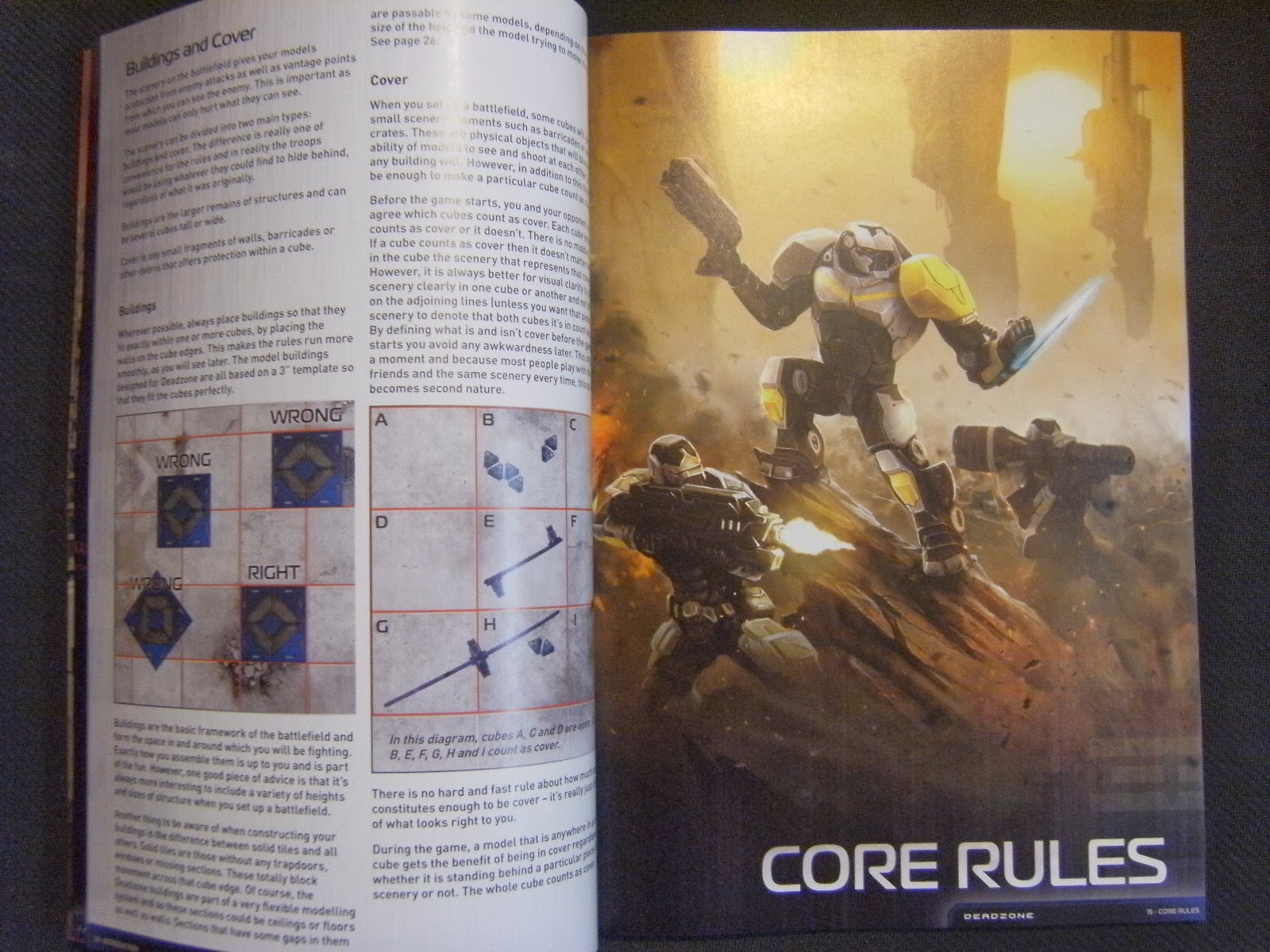
Seeing as we just mentioned the Sedition Wars rulebook we might as well take a moment to look at the pair of them.  Straight away Mantic have thrown down the gauntlet, with Deadzone's rulebook being very much a bound book in its own right.  The Sedition Wars rulebook by comparison is still sizeable, but doesn't have that same feeling of opulence when flicking through its pages.
 
Sedition Wars: She'd better watch where she's pointing that thing!
 
Deadzone: Cor! Rules!
Inside, both are of a similar nature, containing exactly what you'd expect from a rulebook.  Both give a rundown on the games' warring factions as well as a brief background to their respective universes.  The rules are obviously covered, and both include details for running campaigns if you fancied something more in-depth than a simple one time game.
 
There are still a couple of elements to follow, but we'll move onto the big one now: gaming pieces!
 
The many and varies bags of Sedition Wars.
The less many bags of Deadzone.
From a first impression, Sedition Wars does seem to take a lead over Deadzone in this respect, with the box featuring 50 miniatures to Deadzone's 23.  With both games having that tabletop element, these are provided unassembled and unpainted, with players needing to rely on their hobby skills to get them ready for action.  This does make the higher model count something of a double-edged sword, as it's great to have more toys to play with, but obviously means more prep-time is needed before they're ready to go.  Of course, Deadzone's scenery sprues will go some way to balancing this out.
The level of details on both sets of models is certainly very nice, but Deadzone claws some points back from Sedition Wars with regards to casting quality.  Whilst both will need some filing before assembly to rid the models of unsightly mould lines, those in Sedition Wars do feature considerably more flash which needs to be clipped off  before assembly.  This might not sound like much, but with 50 models to trim back we can bet it's going to be a time-consuming process!.
 
One of the things which made the comparison between the two games easier to draw was the nature of the models.  In both cases the factions seem to be split into futuristic human military on one side, and zombie-like genetic mutations on the other.  At the time of writing this article we haven't finished any models on either side yet, but the following stock images from both manufacturers show the finished quality on their respective miniatures...
 
Sedition Wars' Vanguard.
 
Deadzone's Enforcers.
 
Sedition Wars' The Strain.
Deadzone's Plague.
 
Some lovely models here on both sides.  From a personal point of view, we have to say we prefer the humans of Deadzone's Enforcers over those of Sedition Wars' Vanguard.  The stylised oversized heads and hands of the models has never been something we're fans of, much preferring the normal human scaling favoured in the Deadzone range.  However when it comes to The Strain vs Plague it's a much closer run thing!  With no scaling standard when it comes to genetic abominations, these figure ranges boil entirely down to the detail level in the castings, and as you can see above there's not much between them!  At a push we'd probably say we just about favour The Strain, but again that's personal preference entirely.
There are two further points that must be raised here, both in favour of Sedition Wars.  First of all, the bases included with its models are scenic, making the miniatures look as though they are standing on the decking of a ship rather than the plain smooth bases of Deadzone.  Secondly, the bases have handy little slots underneath them for clipping in plastic markers to signify status changes in the characters.  This is a very nice touch, and makes a refreshing change from having to place tokens next to miniatures or beside their character cards.  Kudos to Studio McVey for this simple, yet innovative idea.
 
The character cards of Sedition Wars.
The faction decks of Deadzone.
With any kind of system like this, sets of cards are usually a given.  In the case of Sedition Wars, stat cards are provided for each miniature, giving players a quick-reference guide to their stats and abilities.  With Deadzone it's a little different.  Both sides have a 54-card Faction Deck.  As well as statistics for each miniature, this deck also contains actions and objectives, mixing things up a little and giving an extra level of depth to the game.
 
Sedition Wars certainly isn't shy on the token front.

...but neither is Deadzone, come to that.
Both games feature a plethora of tokens, to signify all kind of weird and wonderful things (we could go into detail, but that would probably require a whole article to itself!).  More isn't necessarily better when it comes to tokens, so there are no points to be dished out there, but in terms of quality the tokens from Sedition Wars are printed on higher quality card, and so will probably take more punishment before starting to go dog-eared.  However, they are only printed on one side, which is unusual for game tokens, and so unless players are incredibly well organised it may be a nuisance trying to find the one you're after in a hurry.
 
The only unmentioned aspect of the box contents is the dice, as there's nothing particularly special about dice!  Sedition Wars works on a D6 system, and so contains 8 standard D6's, whereas Deadzone is based on D8's, so contains 6 of these.
 
To end this box contents comparison we will make a quick note on the actual box interiors, as these can be something of a sticking point for us, as mentioned when we reviewed Bioshock Infinite: The Siege of Columbia.
 
 
Sedition Wars doesn't feature the greatest box insert in the world, but there's something there at least, and it features the same artwork as on the box cover.  The channel down the centre is enough to contain the tokens and cards, although doesn't really provide much protection for the miniatures (especially once they've been lovingly painted!).  The raised sections to the side allow the boards and rulebook to rest snugly on top, so all-in-all Sedition Wars is designed to be carried around as a self-contained unit.
Deadzone on the other hand, is a plain white box on the inside (hence us not bothering with a photo.  There are no sections for keeping the cards, the dice, the tokens... anything, basically.  It's a sizable box, and if you were to attempt to carry it around then we wouldn't like to imagine the state your various game components would be in when you reached your destination.  It seems very much as though it's been designed to be discarded after opening, requiring the additional purchase of some kind of carry-case to make transport feasible.  Again, looking at this from a board gamers' perspective, it's a notch in the negative column for Mantic's new release.
 
So that's the box contents of these two mammoth games!  At this point it's difficult to say which of the two is coming out on top.  Sedition Wars boasts more miniatures, and there's not a great deal between them in terms of quality.  Deadzone's scenery looks set to give a more immersive gameplay experience, but Sedition Wars' modular gaming board allows for a decent degree of customisation.  Deadzone has the nicer rulebook, but Sedition Wars score points for including a box which can transport the game as a whole.
From this initial comparison we'd probably say that neither games is shaping up to be a superior overall product, but Sedition Wars is in the lead as far as being a self-containted board game goes.  With both systems looking very intricate it may be a couple of weeks before Part 2 of this comparison hits your screens, as we want to make sure we do both games justice!  If you've been lucky enough to get your hands on an early copy of Deadzone though, or have played Sedition Wars in the past, we'd love to hear your opinions in the comments section.  For now, take care, and happy gaming!

Thursday, 1 August 2013

Zombie Fluxx: The Ever-Changing Zombie Card Game

Following on from our reviews of Monty Python Fluxx and Zombies!!!, Games & Tea are going to combine the two as we take a look at Zombie Fluxx from Looney Labs.
 
 
Zombie Fluxx, as the name implies, is a Zombie themed version of Andrew Looney's flagship game.  Seeing as all Fluxx decks follow the same set of basic rules, there's very little point in us going into them in great detail.  If you're a Fluxx newcomer then you can check out our Monty Python Fluxx review here to get a breakdown on how the game is played.
 
The very first thing you'll probably notice upon starting a game of Zombie Fluxx is the incredibly high number of Creepers in the deck.  Most Fluxx variations contain 3 or 4 Creepers, but with Zombie Fluxx they have well and truly gone to town...
 
 
That's right, you're looking at a whopping 15 Creeper cards right there!  This may, at first glance, seem like Looney Labs have gone slightly overboard, but with Zombie Fluxx this high Creeper content works, and does so for a number of reasons.
First of all, this is a zombie game.  The very nature of zombies is that their strength is in their numbers.  In order for Zombie Fluxx to keep the feel of a zombie apocalypse the gaming table needs to be overrun with zombies, and that's just what this Creeper overload achieves.
Secondly, they feel more like a different level of Keeper than your typical Creeper.  Many of the goals require zombies in order to win the game, so you'll often find yourself wanting to collect zombies.
Thirdly, they don't stick around.  With a higher number of Creeper cards comes a higher number of Creeper-removal cards.  Keepers like The Shotgun allow you to kill one of your zombies each turn, and there are New Rules such as Zombies Ain't So Bad which allow you to win on a non-zombie goal even if you have Creepers galore, or you can use Look, Over There! to move a zombie to an opponent who has Brains, Sandwiches, or a number of other food-based Keepers on the table..  On top of this, several of them move of their own accord.  A Zombie Trio (or a Trio of Zombies) travels to an adjacent player when it would be destroyed, a Pair of Zombies can be palmed off onto any other player if another on of your Creepers dies, and Larry The Zombie quite merrily wanders around the board in a counter-play direction every time the Goal changes.  Larry is also perhaps the only true Creeper in the deck, as there are no conditions under which you can win whilst he's in your possession.  Oddly this seems to make him something of a fan favourite, rather than a hated nemesis.
 
The other thing which makes Zombie Fluxx a little different is the addition of a new card sub-type.  This was first introduced in Zombie Fluxx and has since crept its way into a few other Fluxx variants where appropriate, but is by no means a standard part of every deck.
 
 
Ladies and gentlemen, we present you with the Ungoal!  This is played in the same was as a regular Goal, but results in every player losing the game.  After all, what kind of zombie apocalypse would it be if there wasn't the chance of a Zombie Victory?  This card is especially fun when playing with a team of hardcore zombie fans, as you'll often find at least one player who will throw this down out of nowhere, having been secretly hoping for the zombies to win all along!
 
Aside from those two interesting notes, the rest of the deck is very much standard Fluxx fare, albeit with a zombie theme.  The New Rule and Action cards consist largely of those found in standard Fluxx, with a few zombie-themed cards thrown into the mix.  The Keepers, and subsequently the Goals, are all zombie-themed, with several zombie clichés available to aim for.
 
 
Throughout the course of the game you may find yourself needing to Barricade The Windows.  You could get your Chainsaw at the ready and declare Zombie Season open.  But be careful, if your Friend is turned into a zombie then the Dead Friends New Rule means you'll have to kill them first!
 
So how does it compare to the other Fluxxes on offer?  The high Creeper content gives it a very different feel of play to its counterparts, but this is by no means a bad thing.  If anything it makes the game feel more fun, as forward-planning goes straight out the window and thinking on your feet becomes the only viable plan.
Unlike the previously reviewed Monty Python Fluxx, there is no specific franchise here, just a general zombie theme.  Zombies have been a firm favourite in popular culture for a very long time, but especially with them being in the ascendency in recent years, you'll be unlikely to have a hard time finding willing players.
 
At the end of the day though, even with the zombie element driving the game, it's still Fluxx at its core.  As we mentioned in the Monty Python Fluxx review, this is something of a Marmite game amongst gamers, as the strong focus on chance and almost complete absence of tactics will not be everyone's cup of tea.  If you aren't a fan of Fluxx on the whole, then Zombie Fluxx is unlikely to do anything to change your mind.
 
The Good Points
  • Zombies!  Not only is this a good point on account of the fact that zombies are awesome, but also because of the fact that most people agree that zombies are awesome!  This very popular theme means that willing Zombie Fluxx players are rarely hard to come by.
  • The standard Fluxx benefits apply here; it's easy to learn, easy to customise, and a nice compact game to carry around.
  • Whilst it can be a quick game with a few players, Zombie Fluxx is quite enjoyable to play with multiple players for an extended period.  The chaotic nature of the zombie outbreak is fun to get caught up in, and it doesn't feel as though it's dragging when the games start to approach the hour mark.
The Bad Points
  • As a luck-based, largely non-tactical game, it won't appeal to some gamers.
Recommended Number of Players: 3+
Fluxx in general doesn't work quite so well with just 2 players.  It's still a good game, but with 3 players or more then the whole game can change whilst you wait for your turn to come back around.  For a good all-round Zombie Fluxx experience, this is the minimum number you want to be aiming for.
 
Replay Value: High
Zombie Fluxx is an excellent wind-down game, and with it being an enjoyable yet generic theme, it's a lot of fun to keep returning to.
 
The Future: n/a
Each version of Fluxx is its own game, and as such the contents of the box are all you'll ever get of Zombie Fluxx.  However if you've enjoyed the mechanic then there are several other themed Fluxx sets to choose from, including Monty Python Fluxx, Oz Fluzz, Martian Fluxx, Cthulhu Fluxx and Stoner Fluxx.
 
Price: £12
Zombie Fluxx will set you back roughly £12, which is a thoroughly decent price for a stand-alone card game.  The various Fluxx sets seem to be standard fare in most specialist game shops, and with zombies more popular than ever, Zombie Fluxx does seem to be one of the most easily available.


OVERALL SCORE: 4/5

If you enjoyed this article and want to see more of the same, come and like us on our Facebook page to keep up to date with our reviews, as well as our general day-to-day ramblings!